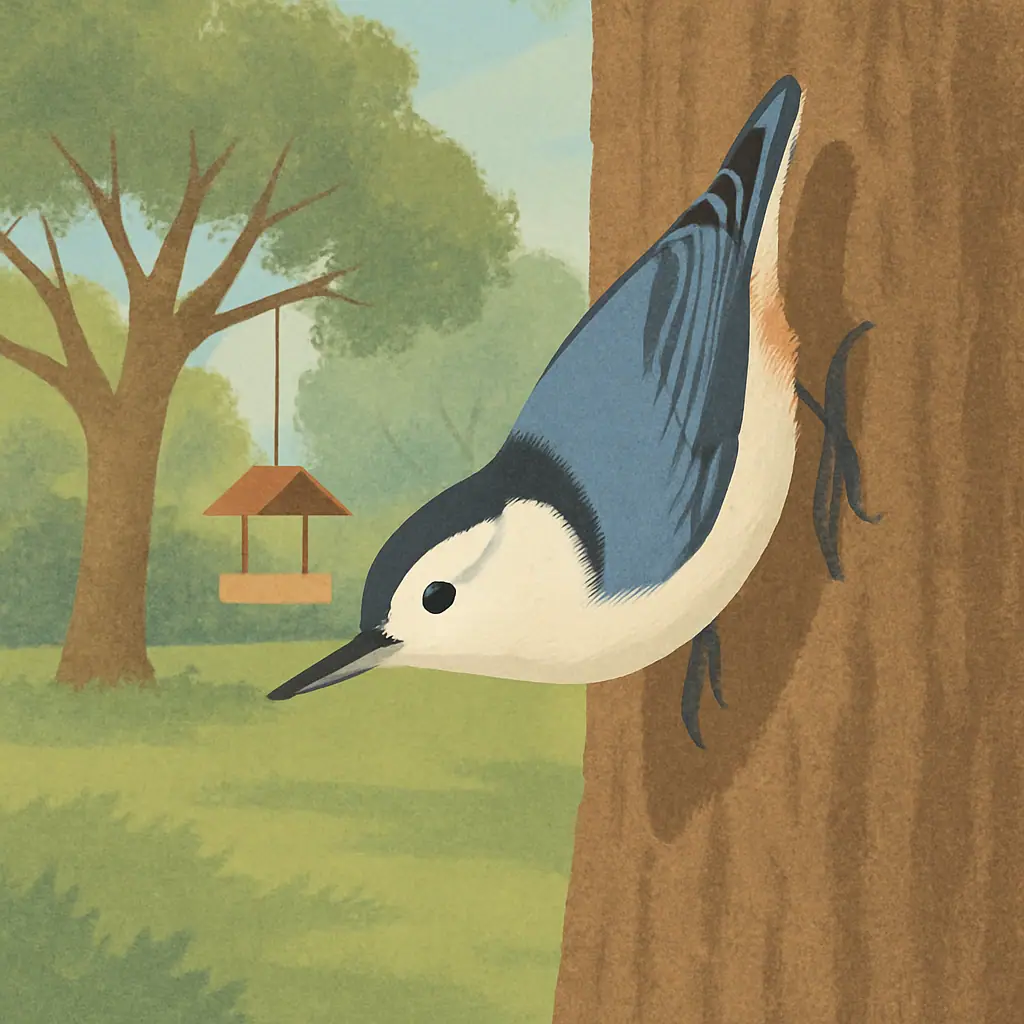
White breasted nuthatch identification becomes much easier when you stop expecting birds to behave politely on branches. This small backyard visitor often walks headfirst down a tree trunk, slips sideways along bark, and seems to inspect every crack like a tiny house painter checking old trim.
For beginners, that upside-down habit is one of the friendliest clues in birdwatching. The Audubon Field Guide describes the White-breasted Nuthatch as a compact bird with a large head, short tail, long pointed bill, blue-gray back, and clean white face and underside. It also notes the bird's nasal call and its habit of creeping over trunks and major limbs. In a quiet yard with mature trees, you may hear its voice before your eyes find the bird.
What Is a White-Breasted Nuthatch?
The White-breasted Nuthatch is a small songbird often seen in woodlands, parks, older neighborhoods, and backyards with large trees. It belongs to a family of birds famous for moving around tree bark in ways that look almost gravity-free. While woodpeckers usually brace themselves with stiff tails and move upward, nuthatches can travel up, down, and sideways with quick confidence.
Think of this bird as a little bark inspector. It searches crevices for insects and also carries seeds away from feeders to crack or store them. Once you recognize the shape and movement, it becomes one of the most satisfying birds to spot from a window or porch.
Quick beginner snapshot
- Size: Smaller than a robin, stocky, and often large-headed for its body.
- Shape: Short tail, strong feet, long pointed bill, and a compact body.
- Color: Blue-gray back, white face and belly, and a black or gray cap depending on sex and age.
- Voice: A nasal, repeated call often described as a soft yank-yank or ank-ank.
White Breasted Nuthatch Identification: Shape and Color
Start with outline. A White-breasted Nuthatch has a short tail, a sturdy body, a fairly large head, and a long straight bill. From a distance, it may look like a small moving wedge pressed against the bark. The clean white face and underside make it brighter than many chickadees or sparrows, especially when sunlight hits the trunk.
The back is blue-gray, the face is mostly white, and the crown is dark on many adults. The bill looks longer and more pointed than a chickadee's bill. Because it often clings sideways or upside down, the bird may not give you a classic side view. Watch a few seconds longer and let movement complete the identification picture.
What to compare it with
A chickadee is rounder, usually shows a bold black cap and bib, and hops more through twigs than down trunks. A woodpecker is generally stiffer, often has a stronger tail brace, and may hitch upward; if that comparison feels tricky, BirdPeep's Downy vs. Hairy Woodpecker guide can help you practice shape and posture clues. A Red-breasted Nuthatch is smaller, has a strong eye stripe, rusty underparts, and is more common in conifer settings. The White-breasted Nuthatch looks cleaner, larger, and brighter underneath.
The Upside-Down Tree Walker Behavior
This bird's behavior is not just charming; it is practical. By moving downward, a nuthatch can inspect bark angles that upward-moving birds may miss. It probes cracks, lifts tiny bits of bark, and searches for insects, spiders, and hidden seeds. Watching one work a trunk can feel like seeing nature turn a page you did not know was there.
Near feeders, the same purposeful style appears. A White-breasted Nuthatch may land, grab one sunflower seed or peanut piece, and fly to a nearby tree. There it can wedge the food into bark and hammer it open with its bill. Cornell notes that these birds also cache food, saving pieces in bark crevices for later.
- Watch the direction: Headfirst downward movement is one of the easiest field marks.
- Follow the trunk: They often work large branches and main trunks rather than only outer twigs.
- Notice the pauses: The bird may stop, probe, twist, and then hurry to another spot.
- Look after feeder visits: It may carry food to a nearby tree instead of eating at the feeder.
Voice, Feeders, and Habitat Clues
Many beginners first notice the call. The White-breasted Nuthatch often gives a nasal repeated note that sounds a bit like a tiny horn from the trees. It is not the musical song of a wren or the whistle of a cardinal. It has a friendly, slightly honking quality that becomes familiar with practice.
Habitat can help too. These birds like mature deciduous trees, woodland edges, parks, orchards, and wooded neighborhoods. In the backyard, they may visit feeders for black oil sunflower seeds, peanuts, suet, and similar high-energy foods. They are especially enjoyable for window birdwatchers because they often return to the same trees and feeding routes.
How to Welcome White-Breasted Nuthatches Gently
You do not need a complicated yard. Clean feeders, a nearby tree, fresh water, and some natural cover can make your space more inviting. If you offer peanuts or suet, use fresh food and clean equipment regularly, especially during wet or warm weather.
Native trees and shrubs help support insects that birds need through the year. Avoid unnecessary pesticide use, keep cats indoors, and leave safe natural features where practical. If you have a dead branch or snag, only leave it if it is not a safety hazard; cavity-nesting birds benefit from natural holes, but people and homes come first.
Pros and Cons of Learning This Bird First
Memorable movement
The headfirst tree-walking behavior is much easier to remember than a long list of feather details.
Good feeder visitor
Many beginners can study this bird comfortably from a kitchen window, patio chair, or porch.
Helpful voice clue
The nasal call can guide your eyes toward the right tree before the bird is visible.
Quick movement
It may disappear around the far side of a trunk just when you think you have a perfect view.
Similar relatives
In some regions, you may also need to compare it with Red-breasted or Brown-headed Nuthatches.
Frequently Asked Questions
Why do White-breasted Nuthatches walk upside down?
Moving headfirst down trunks lets them search bark from a different angle and reach insects or hidden food in crevices other birds may miss.
What food attracts White-breasted Nuthatches?
They commonly visit feeders for sunflower seeds, peanuts, suet, and peanut butter-style foods. Freshness and feeder cleanliness matter more than variety.
Are White-breasted Nuthatches woodpeckers?
No. They are nuthatches, not woodpeckers. Both use tree trunks, but nuthatches have their own short-tailed shape and distinctive down-the-trunk movement.
What is the easiest beginner clue?
Look for a small blue-gray and white bird with a long bill moving headfirst down a tree trunk while giving nasal calls.
Final Thoughts
The White-breasted Nuthatch is a lovely reminder that birdwatching rewards patient eyes. At first, you may only notice a quick pale shape on bark. Then you see the short tail, the long bill, the clean white face, and that wonderful upside-down walk.
Once this bird becomes familiar, every mature tree in your yard feels a little more alive. Pour a cup of coffee, listen for the nasal call, and let the upside-down tree walker introduce itself at its own pace. If you enjoy keeping gentle notes on sightings, the BirdPeep nature journal guide pairs nicely with this kind of slow observation.