Estimating a bird’s size can feel surprisingly hard when the bird never sits still for long. A sparrow-sized visitor may look larger when it puffs its feathers, and a robin may seem smaller when it lands far away at the edge of the lawn. That is why many beginners benefit from comparing birds to familiar backyard objects instead of guessing from memory alone.
Once you start using steady reference points, bird identification becomes calmer. You stop asking yourself, “Was that medium or small?” and begin asking better questions: Was it shorter than the feeder port spacing? Did it look about as long as the top of the fence post? Did its body fill most of the bird bath rim or only a small part of it?
Why Size Is Such a Helpful First Clue
Color can change with sunlight, season, age, and angle. Size is not perfect either, but it often gives you a steadier place to begin. Audubon’s overview of how to identify birds explains that overall proportions and size are useful ways to narrow the possibilities, which is exactly why beginners can lean on broad comparisons with confidence.
That does not mean you should try to judge inches in the air. Instead, think in broad comparisons. Is the bird closer to a chickadee, a robin, or a mourning dove? That kind of estimate is useful because it quickly removes many look-alikes from the list before you study color, behavior, or habitat.
It reduces overwhelm
When several birds appear at once, size helps you sort the scene. One bird may look compact and round, another long and slim, and another clearly larger than the rest even before you notice details.
It works well with other clues
If you also want a wider beginner framework, BirdPeep’s article on common backyard bird families pairs nicely with size estimates. Families often begin to make more sense when you already know whether you are looking at a tiny songbird, a medium ground feeder, or a larger yard visitor.
Start With Three Simple Size Groups
You do not need ten categories. Three or four broad groups are enough for everyday backyard birdwatching. Most beginners do well by thinking in familiar birds they already know.
- Small: about the size of a chickadee, wren, or small finch.
- Medium: around robin or blue jay size, depending on shape.
- Large: closer to dove, crow, or woodpecker size.
- Extra-large for the yard: anything that clearly stands above those groups, such as a hawk or large water bird in a nearby park.
These groups are not scientific measurements. They are observation shortcuts. Your goal is to place the bird in a useful neighborhood of size, not to guess whether it is exactly six and a half inches long.
Use Familiar Backyard Objects as Quiet Rulers
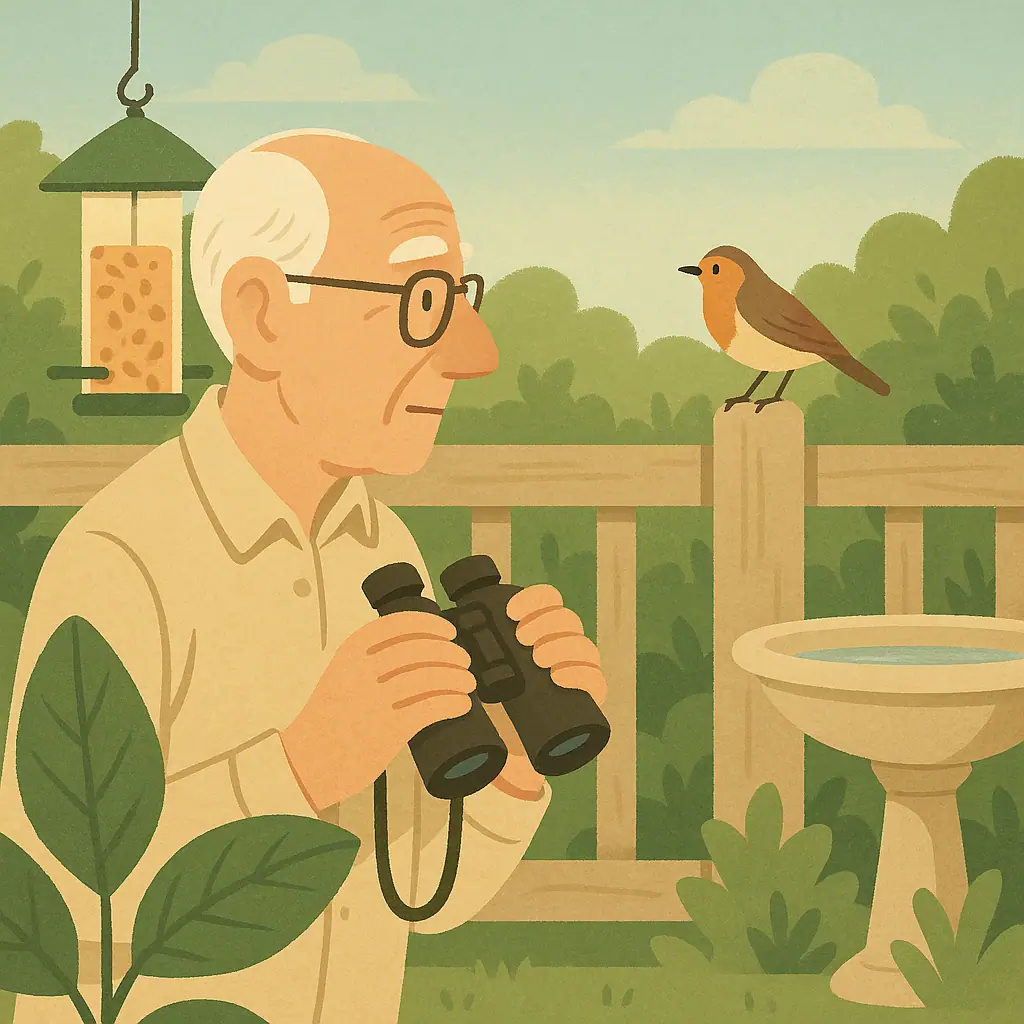
The easiest reference points are objects that stay put. Birds move. Feeders, rails, leaves, shepherd’s hooks, bird bath rims, and deck boards usually do not. If you watch the same yard day after day, those objects become your gentle rulers.
A feeder port is helpful because many birds pause right beside it. A fence rail is helpful because it gives you a clean horizontal line. A broad sunflower leaf, suet cage edge, or bird bath lip can do the same. After a week or two, you begin to feel which birds barely cover that space and which ones stretch beyond it.
Useful objects to compare against
- Feeder ports and perches: good for chickadees, finches, nuthatches, and other small visitors.
- Fence post tops: helpful when birds pause before dropping to the ground or feeder.
- Bird bath rims: useful for medium birds because the circular edge gives a clear visual boundary.
- Deck rails or patio chair backs: helpful for side views when birds sit still for a moment.
- Large leaves or flower heads: useful in summer when birds move through garden beds.
Compare the Bird Before You Reach for a Name
A common beginner mistake is trying to name the bird too quickly. Instead, pause and compare first. Notice how much space the bird seems to take up on the object where it lands. Does it fit neatly inside the width of the rail top? Does its tail extend well beyond the feeder perch? Does it look tall and narrow or short and rounded?
This is also where shape matters. Two birds may be similar in length but feel very different because one has a long tail or a thicker chest. Audubon’s bird identification hub at Identifying Birds is a useful next stop when you want to pair a rough size estimate with shape, behavior, and other field clues in a calmer step-by-step way.
If you like practicing with a little structure, BirdPeep’s guide to describing an unknown bird for identification can help you turn that first size impression into a better full description.
Watch for Distance and Posture Tricks
A bird at the back fence can appear smaller than a bird on the feeder only a few feet from your window. A fluffed-up junco can seem bigger than it really is. A long-tailed bird can look larger overall even when its body is not especially large.
That is why size estimates work best when you compare birds on the same object or in the same part of the yard. If a house finch and a chickadee both use the same feeder perch, the difference becomes more trustworthy than a comparison between one bird on a distant tree and another on the patio.
Three easy corrections to remember
- Closer birds look larger: compare birds at similar distances whenever possible.
- Fluffed feathers add bulk: cold or resting birds may look chunkier than usual.
- Tail length changes the impression: decide whether you are judging total length or just body size.
Practice With Birds You Already Know
The best way to learn size is to start with birds you can already recognize confidently. If you know a mourning dove, a robin, and a chickadee, you already have three excellent size anchors. Every new bird can be compared to one of them.
You can even say the comparison quietly to yourself: smaller than a robin, longer than a chickadee, stockier than a finch, almost dove-sized but lighter-looking. That kind of language may feel simple, but it teaches your eye to notice proportion instead of chasing perfect numbers.
If sound helps you find the bird before you judge its size, BirdPeep’s article on calls and songs can make those first seconds of observation more productive.
Keep a Small Note Beside Your Window or Chair
You do not need a full journal every time. A sticky note, notepad, or phone note works fine. Write the date, the bird, the object you compared it to, and one quick conclusion such as smaller than fence post top or body filled half the bath rim.
Over time, your notes become a quiet personal guide. They also help you notice when two birds you once mixed up are not actually the same size at all. Many beginners discover that the act of writing the comparison once or twice makes the next sighting much easier to judge.
- Keep it short: one line per sighting is enough.
- Use the same objects: repeated references make your notes more reliable.
- Add one extra clue: shape, tail, posture, or behavior helps confirm the size impression.
- Do not chase perfection: useful notes beat precise notes you never write down.
Pros and Cons of Using Backyard Objects for Size Estimates
It makes bird size feel less abstract
Comparing a bird to a feeder port or fence rail is often easier than guessing inches from memory.
It improves identification without expensive gear
You can build a stronger eye for size using the yard you already have and the birds that already visit it.
It builds confidence through repetition
The more you compare birds to the same steady objects, the faster broad size groups begin to feel natural.
Distance can fool the eye
A far bird and a near bird can seem very different in size even when they are not.
Shape can confuse the estimate
Long tails, fluffed feathers, or crouched posture may change the impression if you rush the comparison.
A Simple Checklist for Estimating Bird Size
Use this quick routine whenever an unfamiliar bird lands in view.
- Pick the object first: notice the rail, perch, bath rim, or leaf before the bird moves again.
- Choose a broad size group: think chickadee-sized, robin-sized, or dove-sized rather than exact inches.
- Check body shape: ask whether the bird looks compact, long, upright, slim, or round.
- Correct for distance: trust comparisons more when birds use the same object or part of the yard.
- Add one more clue: tail length, feeding style, call, or posture can confirm the estimate.
- Write a short note: a one-line comparison helps the next sighting feel easier.
When to Ask for More Help
If a bird still feels confusing after you compare its size, do not force an answer. It is better to leave the bird unidentified than to build a confident memory around the wrong species. Size is a starting clue, not a promise.
That is a good moment to use a trusted app, a field guide, or one of your saved BirdPeep articles to narrow the possibilities. A calm comparison of size, shape, and behavior usually gets you farther than a rushed guess based only on color.
Frequently Asked Questions
What if I never get a bird close enough to compare clearly?
Try using broader size groups and wait for repeat visits to the same branch, feeder, or fence line. Even distant birds become easier to judge once you know the usual objects in that part of the yard.
Should I think in inches or in familiar birds?
Familiar birds are usually easier for beginners. Comparing an unknown bird to a chickadee, robin, or dove is often more useful than trying to estimate exact measurements.
Why do two birds of the same size sometimes look different?
Posture, tail length, fluffing, and viewing angle can change the impression. That is why it helps to combine size with shape and behavior instead of relying on size alone.
Can this help even if I watch birds without binoculars?
Yes. Familiar backyard objects are especially helpful when you are watching with the naked eye because they give you a steady visual comparison even during short sightings.
Final Thoughts
Estimating bird size does not have to feel technical. In a backyard setting, it can be as simple as learning how a bird looks beside the objects you already know well: the feeder, the rail, the bath, the leaf, or the fence post.
Start small, repeat the same comparisons, and let the skill grow quietly. Before long, you may find that size is one of the first clues your eye notices, and one of the kindest ways to make bird identification feel less overwhelming.