There's nothing quite as heartbreaking as finding a beautiful bird lying still beneath your window. If you've experienced this, you're not alone—and more importantly, it wasn't your fault. Window strikes are one of the leading causes of bird mortality, with researchers estimating that up to 1 billion birds die from glass collisions each year in the United States alone.
The good news? This is a problem we can solve. With a few simple changes to your backyard windows, you can dramatically reduce the risk of bird strikes while still enjoying clear views of your feathered visitors. Let me show you how.
Why Birds Hit Windows (It's Not What You Think)
Birds don't see glass the way we do. When a cardinal or chickadee approaches your window, they're not looking at a solid barrier—they're seeing one of two dangerous illusions:
- Reflections of habitat: Windows act like mirrors, reflecting trees, sky, or shrubs. Birds see what looks like a safe flight path through open air.
- See-through transparency: When birds can see through windows to plants on the other side or vegetation beyond, they perceive a clear path forward.
This isn't a matter of poor bird vision—it's an evolutionary problem. Glass simply didn't exist in nature until recently, so birds haven't developed the ability to recognize it as a solid surface. Even experienced, healthy birds strike windows regularly, especially during spring and fall migration when unfamiliar birds pass through your area.
Window strikes happen most often during territorial chases in spring, when males are defending their space, and during fall migration, when young birds are traveling for the first time.
The Hidden Dangers in Your Backyard Windows
Some windows pose more risk than others. Understanding which of your windows are most dangerous helps you prioritize where to focus your prevention efforts:
- Corner windows: Windows that meet at corners create the illusion of a flight path around your house.
- Windows near feeders: Birds fleeing from predators or territorial disputes may panic and strike nearby glass.
- Large picture windows: The bigger the glass surface, the more likely birds will see reflections or try to fly through.
- Windows with indoor plants: Greenery visible through glass attracts birds who don't realize there's a barrier.
9 Proven Methods to Prevent Birds from Hitting Windows
You don't need expensive solutions to protect birds. Here are methods that actually work, organized from most to least effective based on bird conservation research:
External Window Treatments (Most Effective)
Treatments applied to the outside of windows work best because they eliminate reflections before birds get close. Options include:
- Screens: Standard insect screens reduce collisions by 50-80%. They break up reflections and provide a visual warning.
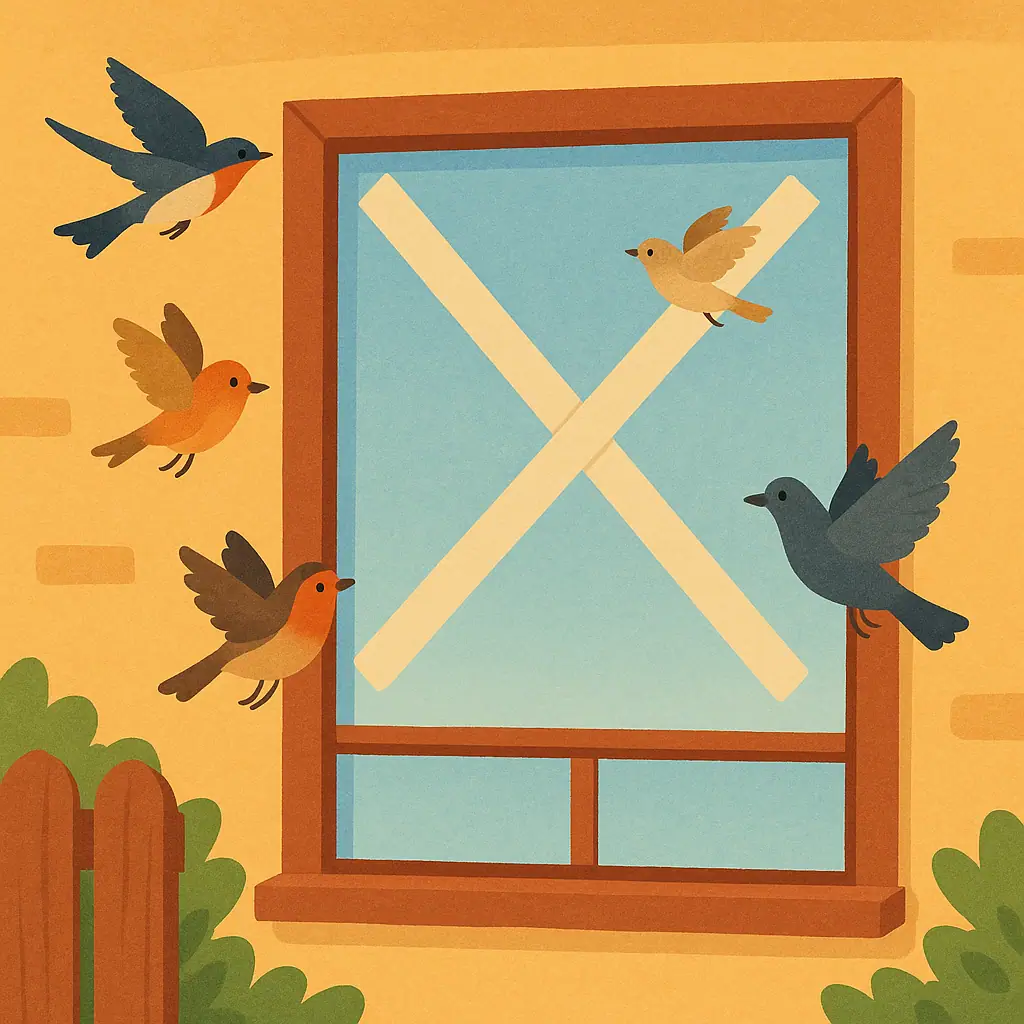
- Tempera paint or soap: Draw vertical lines or dots on the outside of glass, spaced 2-4 inches apart (birds won't fly through gaps smaller than this).
- External decals: Place decals on the outside, following the 2x4 rule: patterns no more than 2 inches apart horizontally, 4 inches apart vertically.
Window Films and Tape
These products adhere to glass and break up reflections effectively when applied correctly.
- Collidescape or Acopian BirdSavers: Professional-grade films designed specifically for bird safety.
- ABC BirdTape: 1/4-inch white tape applied vertically in 4-inch spacing—simple and affordable.
- One-way film: Allows you to see out while making glass visible to birds from outside.
Feeder Placement Strategy
Surprisingly, placing feeders either very close (within 3 feet) or far away (more than 30 feet) from windows reduces strikes.
- Close placement: Birds can't build up enough speed to injure themselves if startled.
- Far placement: Gives birds plenty of space to maneuver without approaching glass.
- Avoid the danger zone: Don't place feeders 10-25 feet from windows—this is where most fatal collisions occur.
Window Decals: What Works and What Doesn't
Many people try those hawk-shaped decals, but here's the truth: single decals don't work. Birds don't avoid predator shapes—they avoid dense patterns. If you use decals:
- Use many decals, not just one or two
- Follow the 2x4 spacing rule
- Place them on the outside of glass
- Use any shape (circles and dots work as well as birds)
Other Helpful Measures
- Close curtains or blinds: Reduces reflections and see-through visibility.
- Turn off indoor lights at night: Especially during migration, lights attract and disorient birds.
- Move indoor plants away from windows: Eliminates the temptation for birds to fly toward visible greenery.
- Add awnings or exterior shades: Physical structures that reduce reflections.
- Plant native shrubs 3-10 feet from windows: Creates a buffer zone and reduces reflection strength.
What to Do If You Find a Stunned Bird
Even with precautions, occasional strikes may happen. If you find a bird that has hit your window, here's how to help:
- Assess the situation from a distance: If the bird is alert and trying to fly, it will likely recover on its own. Keep pets and children away.
- Provide a safe recovery spot: If the bird is stunned but breathing, gently place a cardboard box (with air holes) over it to protect it from predators while it recovers. Don't handle the bird unnecessarily.
- Give it time: Most stunned birds recover within 15-60 minutes. Check on it periodically from a distance.
- Release when ready: When the bird becomes alert and starts moving normally, lift the box and allow it to fly away on its own.
- Know when to get help: If the bird doesn't recover after 2 hours, has visible injuries, or can't stand, contact a wildlife rehabilitator. Never try to feed or water an injured bird.
Making Your Backyard Truly Bird-Safe
The most effective approach combines multiple strategies. You don't need to treat every window—focus on the highest-risk areas first:
- Start with problem windows: Large windows, corner glass, and windows near feeders or birdbaths.
- Test one method first: Try window tape or external decals on your worst window and observe for a few weeks.
- Make it visible: The key is breaking up reflections and creating a visual pattern birds can recognize as a barrier.
- Maintain your solutions: Decals and tape need occasional replacement; screens need cleaning.
Remember, you're not just protecting individual birds—you're contributing to conservation. Every bird that safely navigates past your windows is a bird that can nest, migrate, and raise the next generation.
Comparing Window Strike Prevention Methods
Most effective solution (50-80% reduction)
Breaks up reflections at the source and provides clear visual warning to birds.
Doesn't obstruct your view significantly
Standard window screens allow clear views while preventing strikes.
Long-lasting and low maintenance
Once installed, screens and quality films last for years with minimal upkeep.
Higher upfront cost
Professional window films or custom screens can cost $100-300 per large window.
Installation may require help
Large screens or film application can be challenging for one person.
Affordable and DIY-friendly
Window tape costs $10-20 per roll and is easy to apply yourself.
Effective when applied correctly
Following the 2x4 spacing rule provides good protection.
Flexible and removable
Easy to adjust or remove if needed, especially when renting.
Requires regular maintenance
Tape and decals deteriorate in sunlight and need replacement every 1-2 years.
More visible from inside
The pattern creates a grid effect that some people find distracting.
Common Questions About Window Strikes
Do those hawk silhouette decals actually work?
Not really. Birds don't avoid predator shapes—they avoid patterns. A single hawk decal won't prevent strikes. If you want decals to work, you need many of them spaced 2-4 inches apart across the entire window. The shape doesn't matter; the pattern density does.
Will window strikes stop if I remove my bird feeders?
No. While feeders near windows can increase strikes, birds hit windows regardless of whether feeders are present. The real culprits are reflections and transparency. It's better to keep your feeders and add window treatments than to give up feeding birds entirely.
Can I use ultraviolet decals that are invisible to humans?
UV decals are marketed as invisible to humans but visible to birds. However, research shows mixed results—many bird species don't see UV patterns as clearly as manufacturers claim. Traditional visible patterns (tape, dots, or screens) remain more reliable.
How long does a stunned bird take to recover?
Most stunned birds recover within 15-60 minutes. If a bird hasn't recovered after 2 hours, or if you see obvious injuries (twisted neck, dangling wing, bleeding), it needs help from a licensed wildlife rehabilitator. You can find your nearest rehabber through your state wildlife agency.
Final Thoughts: Small Changes, Big Impact
Every spring morning when I open my curtains, I'm grateful that my windows are now bird-safe. It took less than an hour and about $30 in window tape to protect the cardinals, robins, and chickadees that visit my yard every day. The vertical lines on my glass are barely noticeable from inside, but they've made all the difference.
You don't need to be perfect—just start somewhere. Pick your highest-risk window and try one of these solutions. Watch for a few weeks. You'll likely notice birds changing their flight paths, steering safely around your glass instead of toward it. That's when you'll know it's working.
Protecting birds from window strikes is one of the most direct ways you can help bird populations thrive. It's not about spending a lot of money or transforming your home—it's about making your windows visible to the birds who share your backyard space.