I still remember the morning I watched a determined gray squirrel hang upside down from my "squirrel-proof" bird feeder, methodically emptying every last sunflower seed onto the ground while the cardinals and chickadees watched helplessly from nearby branches. That was the day I realized that squirrels aren't just persistent — they're basically furry engineers with Ph.D.s in problem-solving.
After years of trial and error (and quite a few empty feeders), I've learned that successful squirrel-proofing isn't about finding one magic solution — it's about understanding squirrel behavior and using multiple strategies that actually work together. The good news? Once you know what you're doing, you really can enjoy watching birds without funding a squirrel buffet.
Why squirrels are so successful at raiding feeders:
- Athletic ability: Can jump 10 feet horizontally and 5 feet vertically
- Problem-solving skills: Remember solutions and adapt quickly to new challenges
- Persistence: Will work for hours to solve a "puzzle" for a food reward
- Motivation: High-fat birdseed is like candy to squirrels — worth the effort
- Time advantage: Active all day while birds feed mainly morning and evening
🛡️ Weight-Activated Feeders: The Gold Standard
Weight-activated squirrel-proof feeders are hands-down the most effective solution I've found. These clever devices have springs or counterweights that automatically close seed ports when anything heavier than a bird lands on the perches.
My neighbor Bob installed a weight-activated tube feeder three years ago and hasn't lost a single seed to squirrels since. "It took about a week for the local squirrels to give up," he told me, watching a goldfinch happily feeding while a frustrated squirrel watched from a nearby oak tree.
How They Work:
The magic is in the engineering. Most are calibrated to close when anything weighing more than 1.5-2 ounces lands on them. That's heavier than most songbirds but lighter than squirrels (which typically weigh 12-18 ounces). The mechanism is simple but effective — when weight triggers the spring, metal barriers slide down to cover all seed openings.
Top Weight-Activated Options:
- Tube feeders: Multiple perches, adjustable weight settings, holds 2-6 pounds of seed
- Platform feeders: Larger birds welcome, whole feeder tilts to spill seed
- Cage-style feeders: Outer cage closes around feeder when triggered
- Specialty feeders: Designed for specific seed types (nyjer, safflower, suet)
📏 The 5-10 Rule: Strategic Placement
Even the best squirrel-proof feeder won't work if it's positioned within squirrel jumping range. I learned this the hard way when I placed my first "foolproof" feeder only 3 feet from my deck railing — and watched squirrels launch themselves directly onto it like furry missiles.
The 5-10 Rule is your foundation for any squirrel-proofing strategy: feeders must be at least 5 feet high and 10 feet away from any launch point. This includes tree branches, fences, deck railings, roof edges, and even picnic tables that squirrels can climb.
Understanding Launch Points:
Squirrels are incredible athletes. They can leap horizontally up to 10 feet and vertically up to 5 feet. More importantly, they're smart enough to scout your yard and identify every possible approach route.
⚠️ Common Launch Points People Miss:
- Gutters and roof edges: Squirrels climb down from above
- Neighboring structures: Fence posts, shed roofs, even tall plants
- Utility lines: Squirrels are professional tightrope walkers
- Retaining walls: Provide elevated launching platforms
- Other feeders: Squirrels will use one feeder to reach another
Choosing the Perfect Spot:
- Open ground: Center of lawn or large open space
- Clear sight lines: You should be able to see 10 feet in all directions
- Easy access for refilling: Don't make it harder on yourself than necessary
- Bird-friendly: Some shelter nearby but not too close
🚧 Physical Barriers That Actually Work
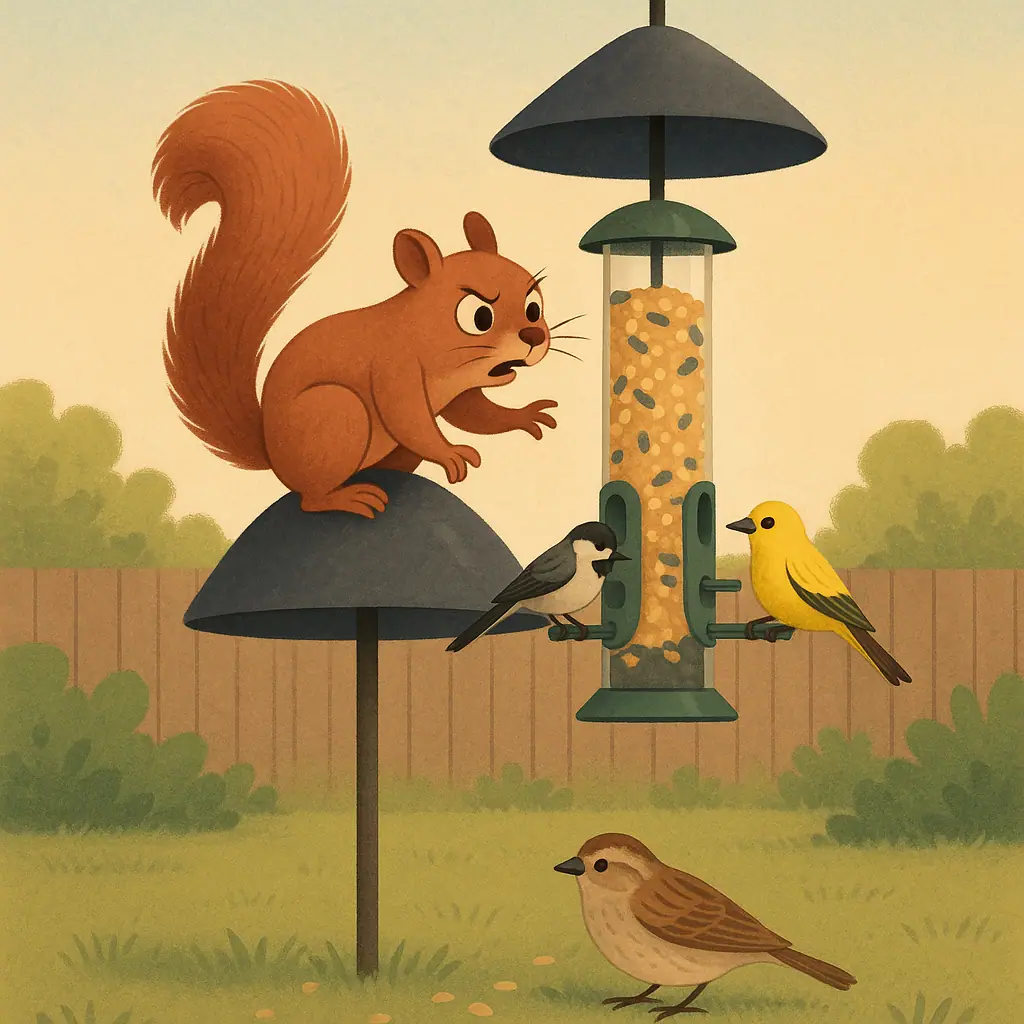
Squirrel baffles — dome-shaped or cylindrical barriers — are incredibly effective when properly installed. I was skeptical at first, but a well-placed baffle can turn even a regular feeder into a squirrel-proof fortress.
Pole-Mounted Baffles:
These mount below your feeder on the support pole, creating an impassable barrier for climbing squirrels. The key is positioning: the baffle must be at least 4 feet off the ground and wide enough (18+ inches) that squirrels can't reach around it.
🏆 Dome vs Cylinder Baffles:
- Dome baffles: Clear plastic or metal, shed rain effectively, 16-20 inch diameter works best
- Cylinder baffles: Metal tubes that spin when squirrels try to climb, often more durable
- Combination systems: Both dome and cylinder for maximum protection
Hanging Baffles:
For feeders hung from branches or hooks, hanging baffles mount above the feeder. They work best when the feeder hangs at least 18 inches below the baffle and follows the 5-10 rule for surrounding launch points.
DIY Baffle Solutions:
- Stovepipe sections: 6-inch diameter metal pipe, 24+ inches long
- Plastic buckets: 5-gallon buckets mounted upside-down on poles
- PVC pipe: Large diameter pipe that spins when squirrels try to grip
🌶️ Deterrent Seeds and Feeding Strategies
Not all birdseed is equally attractive to squirrels. Some seeds that birds love are actually unappealing to squirrels, giving you a natural way to discourage unwanted visitors without affecting your feathered friends.
Safflower Seeds: The Secret Weapon
Safflower seeds have a slightly bitter taste that squirrels dislike but cardinals, chickadees, and house finches love. I switched to safflower in one of my feeders and watched squirrels take a few seeds, make disgusted faces, and walk away. Meanwhile, the cardinals clean it out regularly.
Nyjer (Thistle) Seeds:
Nyjer seeds are tiny, oil-rich seeds that require special feeders with small holes. Squirrels find them difficult to extract and generally not worth the effort. Goldfinches, siskins, and purple finches, however, consider nyjer seeds a delicacy.
Strategic Feeding Approaches:
- Diversified menu: Offer both squirrel-loved and squirrel-ignored seeds in different feeders
- Feeding times: Fill feeders early morning when birds are most active
- Limited quantities: Don't overfill feeders — birds will clean them out before squirrels discover them
- Ground feeding stations: Scatter some corn away from feeders to distract squirrels
🥜 Seeds Squirrels Love (Use in Squirrel-Proof Feeders Only):
- Sunflower seeds: Black oil and striped — squirrel candy
- Peanuts: Regular and in-shell — irresistible to squirrels
- Corn: Whole kernel and cracked — squirrel staple food
🛡️ Seeds Squirrels Typically Avoid:
- Safflower: Bitter taste deters mammals but birds love it
- Nyjer: Too small and difficult for squirrels to extract efficiently
- Millet: Not preferred by squirrels, beloved by smaller birds
⚡ Technology Solutions: Motion and Sound
Modern squirrel deterrents use motion sensors, water sprays, and ultrasonic sound to create squirrel-free zones around your feeders. While not 100% effective on their own, they work well as part of a comprehensive strategy.
Motion-Activated Sprinklers:
These devices detect movement and spray a burst of water toward the intruder. Squirrels learn quickly to avoid these areas. The key is positioning them to cover feeder approaches without soaking the birds you want to attract.
Spinning and Moving Feeders:
Some feeders are designed to spin or rock when anything lands on them, making it impossible for squirrels to maintain their balance while feeding. Birds, being lighter and more agile, can often feed successfully from these moving platforms.
Ultrasonic Deterrents:
These emit high-frequency sounds that supposedly bother squirrels but not birds. Results are mixed — some people swear by them, others see no effect. They work best in combination with physical barriers.
🏗️ Multi-Layer Defense Strategy
The most successful squirrel-proofing combines multiple methods. Think of it as building layers of defense rather than relying on any single solution. Even the smartest squirrel will eventually give up if every approach is blocked.
My Proven System:
- Layer 1: Strategic placement following the 5-10 rule
- Layer 2: Physical barriers (baffles on all approaches)
- Layer 3: Weight-activated feeders or caging systems
- Layer 4: Deterrent seeds that squirrels don't prefer
- Layer 5: Distraction feeding (corn scattered away from bird feeders)
Weight-Activated Feeders
Close automatically when squirrels land, 95%+ success rate when properly positioned.
Proper Placement (5-10 Rule)
Foundation of any squirrel-proofing strategy — eliminates jumping access.
Quality Baffles
Physical barriers that work 24/7 with no moving parts or maintenance.
Cayenne Pepper
Temporary at best, can irritate birds' eyes, washes off in rain.
Grease or Oil on Poles
Dangerous for birds, temporary solution, messy to maintain.
Cheap "Squirrel-Proof" Feeders
Often fail quickly, mechanisms jam or break, false economy.
🔧 Maintenance and Troubleshooting
Even the best squirrel-proofing systems need regular maintenance to stay effective. Seeds stick in mechanisms, baffles get dirty, and squirrels occasionally find new approaches you hadn't considered.
Monthly Maintenance Checklist:
- Test mechanisms: Check that weight-activated feeders open and close smoothly
- Clean baffles: Remove seed hulls and debris that might provide grip
- Trim vegetation: Keep branches from growing within jumping distance
- Check mounting: Tighten loose poles, repair bent components
- Observe and adjust: Watch for new squirrel approach routes
When Things Go Wrong:
If squirrels suddenly start succeeding at a previously protected feeder, don't panic. Usually it's a simple fix: a new branch has grown within jumping range, a baffle has shifted, or the feeder mechanism needs cleaning. Do a systematic check of all your defenses.
Frequently Asked Questions
How much should I expect to spend on effective squirrel-proofing?
A quality weight-activated feeder and pole baffle costs $60-100 total. Consider this an investment — squirrels can consume $20+ of birdseed per week. Most people save money within a month of proper squirrel-proofing.
Will squirrel-proof feeders also keep out larger birds like crows?
Yes! Weight-activated feeders typically close when anything over 2 ounces lands on them. This excludes crows, grackles, and other large birds while welcoming cardinals, finches, chickadees, and similar-sized species.
Do squirrels eventually give up, or do I need permanent defenses?
Individual squirrels will often give up after a week of unsuccessful attempts, but new squirrels move into the area regularly. Permanent defenses are necessary — but the good news is that once installed properly, they work indefinitely with minimal maintenance.
Can I use multiple methods together, or will they interfere with each other?
Combining methods is actually the most effective approach! Use strategic placement + baffles + weight-activated feeders for maximum protection. The only conflict is motion-activated sprinklers, which might also spray visiting birds.
Creating Your Squirrel-Proof Action Plan
Ready to reclaim your bird feeders? Start with these steps to build an effective defense system:
- Assess your current setup: Map all potential squirrel launch points around existing feeders
- Choose your primary method: Weight-activated feeders offer the best protection for most situations
- Plan placement: Identify locations that satisfy the 5-10 rule in your yard
- Install barriers: Add pole or hanging baffles as backup protection
- Select appropriate seeds: Consider switching some feeders to safflower or nyjer
- Monitor and adjust: Watch squirrel behavior and refine your defenses
Remember, successful squirrel-proofing is about persistence and consistency, not perfection. Even if a particularly clever squirrel occasionally breaks through your defenses, you'll still prevent 95% of the seed theft while providing reliable feeding opportunities for the birds you want to attract.
The satisfaction of watching squirrels walk away from your feeders in defeat while cardinals and chickadees feed peacefully is worth every dollar spent on proper squirrel-proofing. Your birds deserve a reliable food source, and you deserve to enjoy watching them without funding a neighborhood squirrel buffet.