Few birds announce their presence quite like the red-winged blackbird. With their bold territorial calls echoing across marshes and their unmistakable red shoulder patches flashing in the sunlight, these striking birds are impossible to ignore. While they're most famous as wetland dwellers, you might be surprised to find them visiting your backyard feeders, especially during migration seasons.
During my years as a park ranger, I've observed these fascinating birds in countless environments—from remote wilderness marshes to suburban neighborhoods. Their adaptability and bold personality make them one of the most recognizable yet misunderstood birds in North America.
Let me share what makes red-winged blackbirds such remarkable visitors and help you appreciate these confident birds whether you encounter them near water or right in your own backyard.
\n\n🔴 What Makes Red-Winged Blackbirds Unique
\n\nRed-winged blackbirds (Agelaius phoeniceus) are medium-sized songbirds with personalities far bigger than their 7-9 inch frames suggest. They belong to the blackbird family, which also includes grackles and cowbirds, but their bold territorial nature sets them distinctly apart.
\n\nWhat struck me most when I first started studying them was their incredible confidence. Male red-winged blackbirds will fearlessly chase birds twice their size away from their territory, including hawks and crows. They're like the neighborhood watch of the bird world—always alert, always ready to defend their space.
\n\nKey characteristics that make them special:
\n- \n
- Territorial behavior: Extremely protective of their chosen areas \n
- Vocal communication: Complex calls and songs for different situations \n
- Seasonal migration: Northern populations travel south for winter \n
- Adaptability: Comfortable in marshes, fields, and suburban areas \n
- Social structure: Males often maintain multiple territories \n
Visual Identification Guide
\n\nLearning to identify red-winged blackbirds requires understanding the dramatic differences between males and females—they look so different that many beginning birdwatchers initially think they're separate species.
\n\nAdult Male Red-Winged Blackbird
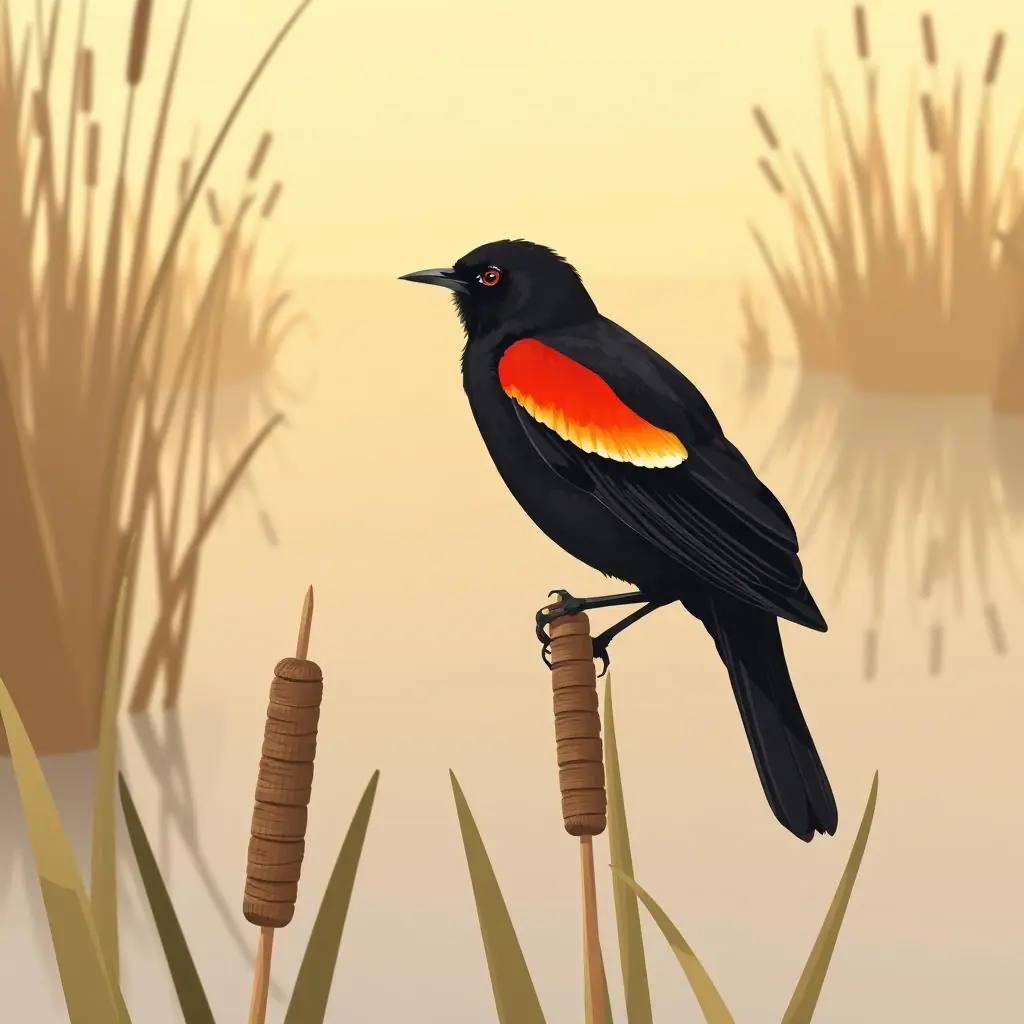
\nMales are the showstoppers of the species. Their glossy black plumage creates a stunning backdrop for those famous red shoulder patches, technically called \"epaulets.\" The red patches are often bordered by yellow, creating a striking three-color display that's impossible to miss when they spread their wings or fluff their feathers during territorial displays.
\n\nAdult Female Red-Winged Blackbird
\nFemales are dramatically different—so much so that I've seen experienced birders do double-takes. They're heavily streaked with brown and white, resembling large sparrows more than blackbirds. Their pointed bills and slightly larger size help distinguish them from actual sparrows.
\n\nSeasonal Variations
\nDuring winter months, males develop rusty feather edges that can partially obscure their black plumage, giving them a more mottled appearance until their spring molt reveals fresh, glossy black feathers.
\n\n- \n
- Male plumage: Glossy black with bright red shoulder patches \n
- Female plumage: Streaked brown and white throughout \n
- Bill: Long, sharply pointed, perfect for their omnivorous diet \n
- Size: Males larger than females (sexual dimorphism) \n
- Posture: Males often display with puffed feathers and spread wings \n
Understanding Red-Winged Blackbird Behavior
\n\nRed-winged blackbirds exhibit some of the most fascinating territorial and social behaviors in the bird world. Their complex social structure and communication systems rival those of much larger birds.
\n\nTerritorial Displays
\nMale red-winged blackbirds are famous for their aggressive territorial displays. They'll perch prominently, spread their wings to show off their red patches, and give loud \"konk-la-ree\" calls to warn intruders. I've watched single males successfully defend territories against much larger birds through sheer determination and strategic positioning.
\n\nSeasonal Behavior Patterns
\nDuring breeding season, males establish territories in prime wetland areas and attempt to attract multiple females. Outside of breeding season, they often form large, mixed flocks that can include hundreds or even thousands of birds.
\n\nThe Calls That Announce Their Presence
\n\nRed-winged blackbirds have a rich vocabulary of calls and songs that serve different purposes throughout their daily lives. Learning these sounds will help you locate and identify them even when you can't see them clearly.
\n\nTheir most famous call is the territorial \"konk-la-ree\" or \"oak-a-lee\" that males use to proclaim their territory. But they also have chuck notes for general communication, alarm calls for predators, and softer contact calls between mates.
\n\nFemales have their own distinct vocalizations, including chattering calls and soft notes they use when communicating with their young.
\n\nHabitat Preferences and Range
\n\nWhile red-winged blackbirds are most associated with wetlands, their adaptability allows them to thrive in surprisingly diverse environments throughout their range.
\n\nPrimary Habitats
\nRed-winged blackbirds prefer marshy areas with cattails, bulrushes, and other emergent vegetation where they can build secure nests and find abundant food. However, they're also common in agricultural areas, especially during migration and winter months.
\n\nBackyard Visits
\nYou're most likely to see red-winged blackbirds in your backyard during spring and fall migration, when large flocks move through suburban areas seeking food sources. They're particularly attracted to areas near water or with abundant seed sources.
\n\nWhat Attracts Red-Winged Blackbirds to Backyards
\n\nIf you'd like to encourage red-winged blackbird visits, understanding their preferences can help you create an attractive stopping point during their travels.
\n\n- \n
- Seed sources: Platform feeders with mixed seeds, cracked corn, and sunflower seeds \n
- Water features: Large birdbaths, ponds, or any standing water \n
- Open areas: Lawns and fields for foraging insects and grubs \n
- Tall perches: Fence posts, tall shrubs, or dead trees for territorial displays \n
- Native plants: Seed-producing plants like sunflowers and native grasses \n
Seasonal Patterns and Migration
\n\nRed-winged blackbirds follow predictable seasonal patterns that can help you anticipate their visits and understand their changing behaviors throughout the year.
\n\nSpring (March-May)
\nMales arrive first to establish territories, followed by females. This is when you'll see their most dramatic territorial displays and hear their loudest, most frequent calls.
\n\nSummer (June-August)
\nBreeding season brings focused territorial behavior near water sources. Backyard sightings become less common as birds concentrate on nesting duties.
\n\nFall and Winter (September-February)
\nLarge flocks form and move through suburban areas seeking food. This is your best chance for backyard visits, especially at feeders stocked with high-energy foods.
\n\nPros and Cons of Red-Winged Blackbird Visits
\n\nDramatic Visual Impact
Males' striking red patches create stunning photo opportunities and memorable sightings.
Pest Control
They consume large quantities of insects, grubs, and agricultural pests during summer months.
Fascinating Behavior
Their territorial displays and social dynamics provide endless entertainment for observers.
Can Be Aggressive
Territorial males may chase away smaller birds from feeders during breeding season.
Large Flocks
Winter flocks can overwhelm feeders and create significant cleanup needs.
Frequently Asked Questions
\n\nWhy do red-winged blackbirds attack people?
\nThey're not truly attacking—they're defending their nests. During breeding season, males become extremely protective and will dive at perceived threats, including humans who venture too close to nesting areas. This behavior stops once young birds fledge.
\nDo females really look that different from males?
\nYes! Females are brown and streaky, often confused with large sparrows. This camouflage helps protect them while nesting in exposed marsh vegetation. Only males have the distinctive black and red coloration.
\nWhen are red-winged blackbirds most likely to visit my backyard?
\nFall through early spring offers the best chances, especially if you live within a few miles of water. During breeding season, they focus on wetland territories and rarely venture into suburban areas.
\nAre red-winged blackbirds harmful to crops?
\nThey can damage grain crops when present in large flocks, but they also provide significant pest control by eating insects and grubs. Their impact varies greatly depending on local conditions and flock sizes.
\nFinal Thoughts on These Bold Beauties
\n\nRed-winged blackbirds embody the wild spirit that many of us seek to connect with through birdwatching. They remind us that nature isn't always gentle and peaceful—sometimes it's bold, territorial, and dramatically beautiful.
\n\nWhether you encounter them at a local marsh displaying their brilliant red patches or discover a winter flock visiting your backyard feeders, these birds offer a glimpse into the complex social lives and survival strategies that make birdwatching endlessly fascinating.
\n\nThe next time you hear that distinctive \"konk-la-ree\" call or spot a flash of red in a nearby field, take a moment to appreciate these remarkable wetland wanderers. They represent the wild heart that beats just beyond our backyards, reminding us that adventure and beauty are always closer than we think.
\n\n