There's something almost magical about watching a mourning dove glide gracefully into your backyard. These gentle birds move with such serene elegance that they seem to bring a sense of peace wherever they land. If you've heard that soft, haunting "coo-oo-oo" echoing through your neighborhood on quiet mornings, you've likely encountered one of America's most beloved backyard visitors.
Mourning doves are remarkably common across North America, yet many new birdwatchers struggle to identify them at first glance. Their understated beauty and quiet demeanor make them easy to overlook, but once you know what to look for, you'll start noticing these peaceful birds everywhere.
Let me share what I've learned about these fascinating birds during my years as a park ranger, and help you appreciate the gentle giants that may already be visiting your own backyard.
\n\n🕊️ What Makes Mourning Doves Special
\n\nMourning doves (Zenaida macroura) are medium-sized birds with a remarkably gentle disposition. Unlike some of their more aggressive cousins, these doves embody tranquility in both appearance and behavior. They're about 12 inches long with graceful, streamlined bodies that seem perfectly designed for their peaceful lifestyle.
\n\nWhat struck me most when I first started observing them was their incredible gentleness. I've watched mourning doves share feeding spaces with smaller birds without any territorial disputes. They simply coexist, embodying the peace their name suggests.
\n\nKey characteristics that set them apart:
\n- \n
- Size: Medium-sized, larger than sparrows but smaller than pigeons \n
- Shape: Slender build with a small, rounded head \n
- Tail: Long, pointed tail with distinctive white edges \n
- Flight: Swift, direct flight with whistling wing sounds \n
- Behavior: Ground feeders that move with deliberate, peaceful movements \n
Visual Identification Guide
\n\nLearning to identify mourning doves becomes much easier once you understand their distinctive features. Their coloring might seem plain at first glance, but there's subtle beauty in their understated appearance.
\n\nAdult Male Mourning Dove
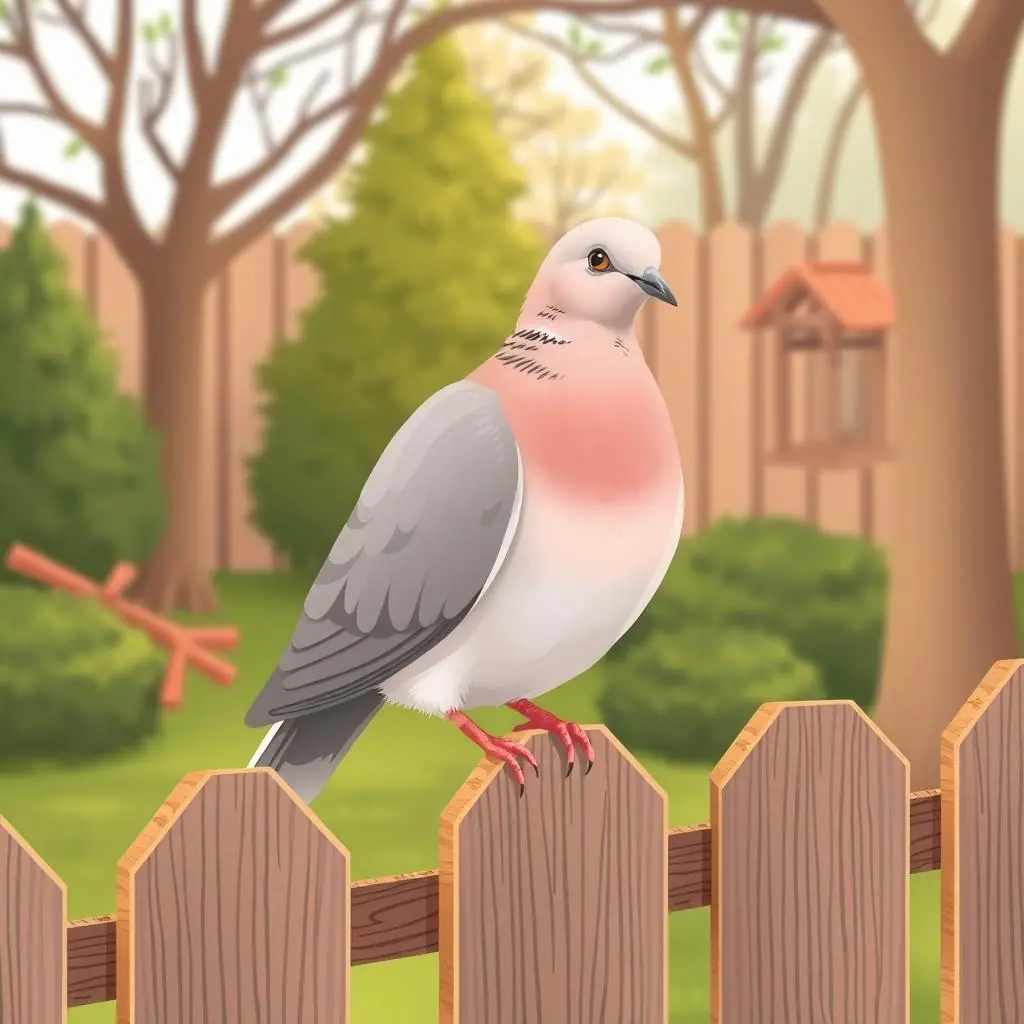
\nMale mourning doves display slightly more vibrant coloring, especially during breeding season. The males I observe often have a subtle pinkish wash on their chest and a blue-gray tint on their crown. Their necks show beautiful iridescent purple and pink patches when the light hits them just right.
\n\nAdult Female Mourning Dove
\nFemales appear more muted overall, with duller brown-gray tones throughout their plumage. They lack the pink chest coloring of males but maintain the same graceful proportions and behavior patterns.
\n\nDistinguishing Features
\n- \n
- Plumage: Soft gray-brown above with black spots on wing coverts \n
- Underparts: Pale peach to light pink (especially on males) \n
- Bill: Small, thin, and black \n
- Legs: Pinkish-red, relatively short \n
- Eye: Dark with thin black line extending behind it \n
Understanding Mourning Dove Behavior
\n\nOne of the most endearing aspects of mourning doves is their predictable, peaceful behavior patterns. They're creatures of habit, which makes them wonderful birds for new birdwatchers to observe and learn from.
\n\nFeeding Patterns
\nMourning doves are primarily ground feeders with a preference for seeds. I've watched them spend long periods methodically searching for fallen seeds beneath feeders, never rushing or competing aggressively with other birds. They have a unique feeding strategy where they'll fill their crop (a storage pouch) with seeds and then find a safe perch to digest their meal.
\n\nSocial Structure
\nThese birds often travel in pairs or small groups, especially during non-breeding seasons. During my ranger years, I noticed they maintain loose flocks that can include dozens of individuals, particularly in areas with abundant food sources.
\n\nThe Haunting Call That Gave Them Their Name
\n\nThe mourning dove's call is unmistakable once you learn it. That soft, melancholic "coo-ah, coo-coo-coo" echoing across quiet neighborhoods has inspired their common name. It's a sound that many people associate with peaceful mornings and calm evenings.
\n\nMales are typically more vocal, especially during breeding season when they use their calls to establish territory and attract mates. I've observed that their calling is most frequent in early morning and late afternoon, creating a gentle soundtrack to the day's beginning and end.
\n\nSeasonal Patterns and Migration
\n\nWhile many mourning doves are year-round residents in warmer climates, northern populations do migrate south for winter. This creates interesting seasonal viewing opportunities depending on where you live.
\n\nSpring and Summer (Breeding Season)
\nThis is when mourning doves are most active and visible. Pairs engage in courtship behaviors including the male's distinctive bowing display and nest-building activities. Their nests are famously simple—often just a loose platform of twigs that looks almost too fragile to support eggs and young.
\n\nFall and Winter
\nNorthern mourning doves begin migrating south in September, while southern populations may see increased numbers as migrants arrive. Winter flocks can be quite large, sometimes including hundreds of birds in optimal habitat.
\n\nAttracting Mourning Doves to Your Backyard
\n\nIf you'd like to encourage mourning doves to visit your backyard, the key is understanding their preferences and providing what they need.
\n\n- \n
- Ground feeding areas: Scatter seeds on the ground or use platform feeders \n
- Preferred seeds: Sunflower seeds, millet, cracked corn, and nyjer \n
- Water sources: Shallow birdbaths or ground-level water features \n
- Perching spots: Dead branches, power lines, or fence posts for resting \n
- Nesting sites: Dense shrubs or trees 5-25 feet high \n
Pros and Cons of Mourning Dove Visitors
\n\nPeaceful Presence
Their gentle nature creates a calming atmosphere in your backyard.
Easy to Observe
Predictable behavior patterns make them perfect for beginning birdwatchers.
Year-Round Interest
Resident populations provide consistent viewing opportunities.
Heavy Seed Consumption
Flocks can quickly empty bird feeders, increasing feeding costs.
Ground Mess
Their ground-feeding habits can scatter seeds and create cleanup needs.
Frequently Asked Questions
\n\nWhy do mourning doves make that sad sound?
\nThe \"mourning\" call is actually a territorial and mating call. Males use it to establish territory and attract females. While it sounds melancholic to us, it's a positive communication for the birds.
\nDo mourning doves mate for life?
\nMourning doves are generally monogamous during a breeding season, but they don't necessarily mate for life. Pairs may stay together for multiple broods in one season but often choose new partners the following year.
\nHow can I tell males from females?
\nMales are slightly larger with pinkish chest coloring and blue-gray crowns. Females are more uniformly brown-gray. During breeding season, males also display more iridescent neck feathers and perform courtship behaviors.
\nAre mourning doves good for gardens?
\nYes! They primarily eat seeds and rarely damage plants. They help control weed seeds and their gentle nature won't disturb other beneficial garden wildlife. Their droppings also provide mild fertilizer.
\nFinal Thoughts on These Gentle Giants
\n\nIn my years of watching birds, mourning doves have taught me the value of quiet observation and patience. They remind us that not every backyard visitor needs to be flashy or dramatic to be remarkable. Sometimes the most memorable birds are those that bring peace and serenity to our outdoor spaces.
\n\nThe next time you hear that gentle \"coo-oo-oo\" echoing across your neighborhood, take a moment to look for these graceful birds. Watch how they move with deliberate calm, how they share space peacefully with other birds, and how they seem to embody the very tranquility that many of us seek in our backyard birdwatching.
\n\nMourning doves prove that sometimes the most beautiful discoveries come not from seeking the exotic, but from truly seeing the everyday wonders that surround us.
\n\n