Last evening, I witnessed one of nature's most spectacular displays: a massive flock of thousands of **European starlings** performing their famous murmuration dance across the prairie sunset. The synchronized swirling and swooping looked like aerial calligraphy written against the amber sky – a reminder that even common birds can create extraordinary moments.
While **European starlings** often get dismissed as "just another backyard bird," they're actually fascinating creatures with complex social behaviors, remarkable intelligence, and stunning seasonal plumage changes. Understanding these adaptable immigrants helps appreciate their role in North American ecosystems and their impressive survival strategies.
Learning **European starling identification** and behavior reveals why these birds have become one of the most successful species on our continent. From their iridescent feathers to their incredible vocal abilities, starlings offer year-round opportunities for observation and discovery.
✨ Year-Round Plumage Changes
**European starling identification** becomes easier once you understand their dramatic seasonal appearance changes – they're literally different birds throughout the year.
Breeding Season Elegance
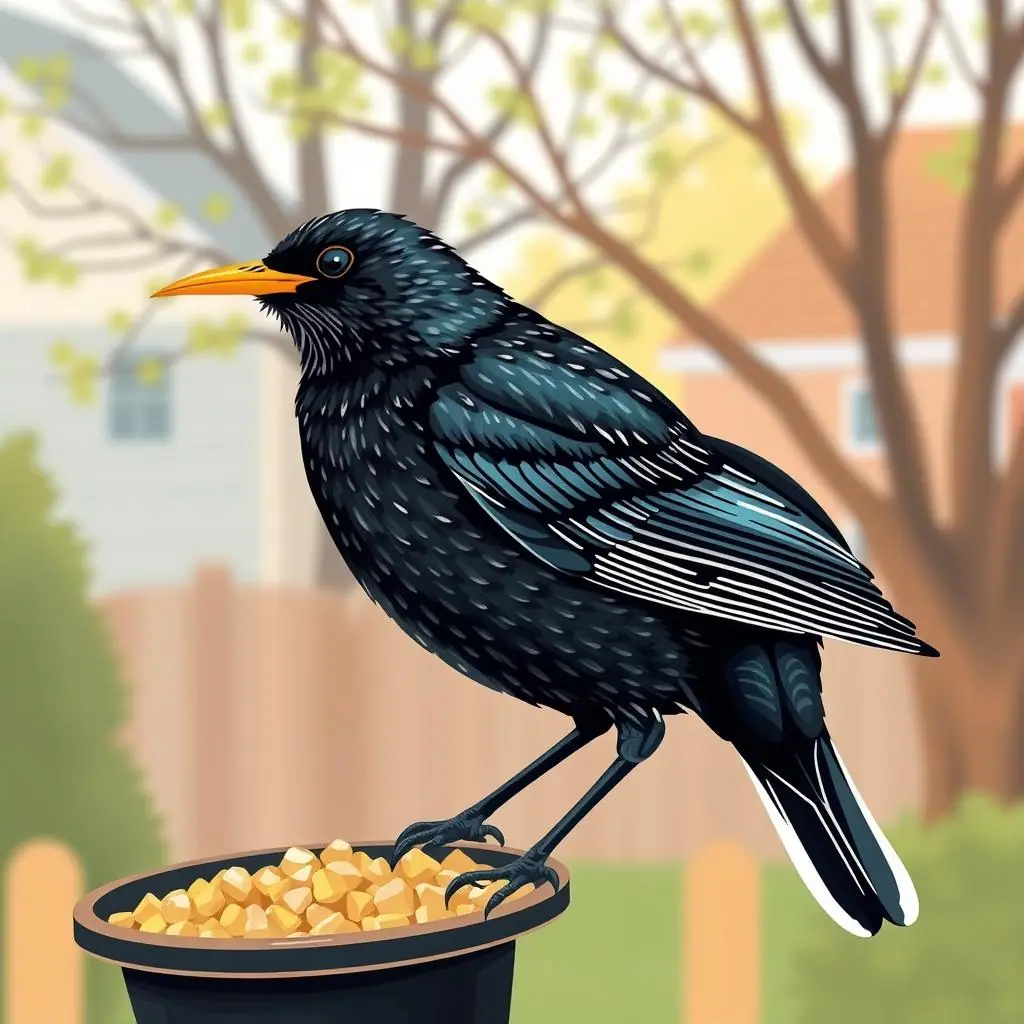
During **spring and summer (March-August)**, **European starlings** transform into glossy, iridescent beauties. Their **black plumage shimmers with purple, green, and blue highlights** that change depending on the angle of light – like an oil slick reflecting rainbow colors.
**Bright yellow bills** replace the dark winter coloration, creating striking contrast with their gleaming black heads. Males develop slightly more intense iridescence and longer, sharper bill points during breeding season.
Winter Transformation
**Fall and winter starlings** look completely different. Fresh feathers have **white and buff-colored tips that create a heavily speckled appearance**. The overall effect resembles a bird wearing a polka-dot sweater – quite charming once you appreciate the pattern.
**Bills turn dark brown or blackish** during winter months, and the iridescent sheen becomes muted. Young birds show even more extensive speckling and appear browner overall than adults.
Physical Characteristics
**European starlings** measure 7-9 inches long with a stocky, compact build. They have **short, squared tails** and **triangular, pointed wings** that create distinctive silhouettes in flight. Their **straight, pointed bills** appear long relative to their head size.
- Body shape: Stocky and compact with large head
- Tail: Short and square-cut, not forked or rounded
- Wings: Triangular and pointed, appear swept-back in flight
- Bill: Long, straight, and pointed – perfect for probing
- Legs: Strong and pink to reddish in color
🧠 Remarkable Intelligence and Mimicry
**European starlings** possess cognitive abilities that rival some of the world's smartest birds, including members of the crow family.
Vocal Virtuosos
**Starling facts** include their incredible vocal range and mimicry abilities. Individual starlings can **learn over 100 different sounds**, including other bird songs, mechanical noises, and even human speech. They're like feathered recording devices with impressive memory capabilities.
Listen for starlings **incorporating car alarms, cell phone ringtones, and other urban sounds** into their repertoires. Each individual male builds a unique song collection used to attract mates and defend territories.
Problem-Solving Skills
Research reveals **starlings can learn complex sequences, recognize patterns, and solve multi-step problems**. They've demonstrated abilities to use tools, understand cause-and-effect relationships, and adapt quickly to new situations.
**Their learning speed** helps explain their success as an introduced species. Starlings rapidly figure out new food sources, adapt to human environments, and modify behaviors based on local conditions.
Insect control
Consume vast quantities of agricultural pests, providing natural pest management services.
Intelligence display
Demonstrate fascinating problem-solving abilities and complex social behaviors.
Spectacular flocking
Create breathtaking murmuration displays during migration periods.
Adaptability
Thrive in diverse habitats from urban centers to rural farmland.
Cavity competition
Compete aggressively with native birds for nesting sites, sometimes displacing species like bluebirds.
Agricultural damage
Large flocks can damage fruit crops and contaminate livestock feed areas.
Invasive status
Non-native species that has fundamentally altered North American bird communities.
🌍 Incredible Flocking Behaviors
One of the most amazing **starling facts** involves their spectacular flocking behaviors, especially the famous murmurations that create aerial art shows.
Murmuration Magic
**Starling murmurations** occur mainly during fall and winter when thousands of birds gather for roosting. These **synchronized flight patterns** result from each bird following simple rules: stay close to neighbors, avoid collisions, and match the average direction of nearby birds.
**Scientists estimate** individual starlings react to the movements of their seven nearest neighbors in just 15 milliseconds – faster than human visual processing. This creates the fluid, wave-like patterns that ripple through massive flocks.
Roosting Communities
**Winter roosting sites** can contain hundreds of thousands of starlings. They prefer **dense vegetation, bridge structures, or urban buildings** that provide shelter from weather and predators.
**Communal roosting** serves multiple purposes: shared body heat for warmth, information exchange about food sources, and safety in numbers. Young birds learn feeding locations by following experienced adults.
🍽️ Diverse Diet and Feeding Strategies
**European starlings** demonstrate remarkable dietary flexibility that contributes to their widespread success across diverse habitats.
Seasonal Food Preferences
**Spring and summer diets** focus heavily on **insects and larvae**, making starlings valuable for natural pest control. They probe lawns systematically, searching for grubs, beetles, and caterpillars with their specialized bills.
**Fall and winter feeding** shifts toward **fruits, berries, and seeds**. Starlings readily adapt to bird feeders, preferring suet, cracked corn, and smaller seeds they can handle easily.
Feeding Techniques
**Starlings use a unique "gaping" behavior** – inserting their closed bills into soil or crevices, then opening them to create space for accessing hidden food items. This technique allows them to exploit food sources other birds miss.
- Ground foraging: Systematic probing of lawns and fields for insects
- Tree feeding: Reaching fruits and berries other birds can't access
- Feeder adaptation: Quick learning of new food sources and feeding stations
- Opportunistic scavenging: Taking advantage of spilled grain, pet food, and garbage
🏠 Nesting and Breeding Habits
**European starling** reproductive strategies combine aggressive competition with dedicated parental care.
Cavity Nesting
**Starlings require enclosed nesting cavities** – natural tree holes, nest boxes, building crevices, or other protected spaces. Males establish territories around potential nest sites, then attract females with elaborate displays and song performances.
**Nest construction** involves both sexes gathering grasses, feathers, and artificial materials to create bulky, dome-shaped structures. They often **reuse successful nest sites** across multiple breeding seasons.
Breeding Success
**Female starlings lay 3-7 pale blue eggs** that incubate for about 12-13 days. Both parents **feed nestlings continuously** for 18-21 days until fledging, making hundreds of feeding trips daily.
**Most pairs raise 1-3 broods annually** depending on local conditions and food availability. This reproductive potential contributes significantly to starling population growth and expansion.
📍 Range and Habitat Preferences
**European starlings** have achieved one of the most remarkable range expansions in modern bird history.
North American Colonization
**All North American starlings descend from just 60 birds released in Central Park in 1890.** Within 70 years, they had colonized the entire continent from coast to coast – a testament to their adaptability and reproductive success.
**Current populations** exceed 200 million birds across North America, making them one of the most abundant bird species on the continent.
Habitat Adaptations
**Starlings thrive in human-modified landscapes** – agricultural areas, suburban neighborhoods, urban centers, and parks. They need **open areas for foraging** combined with **enclosed spaces for nesting**.
- Urban environments: Parks, parking lots, and buildings provide ideal habitat
- Agricultural areas: Farms offer abundant insect food and nesting opportunities
- Suburban neighborhoods: Lawns, gardens, and structures create perfect starling habitat
- Avoiding deep forests: Prefer edge habitats and open areas over dense woodland
Are European starlings harmful to native bird species?
Starlings can compete with native cavity-nesting birds like bluebirds and woodpeckers for nest sites. However, their impact varies by location and habitat management practices can help both species coexist.
How can I tell starlings apart from blackbirds?
Starlings have shorter tails, pointed wings, longer straight bills, and stockier builds. Blackbirds are larger with longer tails, different bill shapes, and distinct flight patterns.
Do starlings migrate?
Most starlings are year-round residents, but northern populations may move south during severe winters. They're considered partial migrants with complex movement patterns.
What's the best way to observe starling murmurations?
Look for large flocks gathering at dusk near roosting sites during fall and winter. Open areas near water, bridges, or large buildings are common murmuration locations.
🔍 Living with Starlings
**European starlings** are permanent fixtures in North American landscapes, making understanding and appreciation more valuable than resistance.
**Appreciating their complexity** transforms how we view these common birds. Their intelligence, adaptability, and spectacular flocking behaviors provide endless opportunities for observation and learning. Even suburban backyards can host fascinating starling watching experiences.
**Managing conflicts** involves understanding starling preferences rather than attempting elimination. Providing appropriate nesting sites while protecting native bird boxes, timing garden activities around their feeding patterns, and appreciating their pest control services creates better coexistence.
**For beginning birdwatchers**, starlings offer excellent practice subjects. Their year-round presence, distinctive behaviors, and seasonal changes provide opportunities to develop observation skills and deepen understanding of bird biology.
**Conservation perspective** suggests viewing starlings as part of our current ecosystem rather than permanent invaders. They've been here for over 130 years, contributing to pest control and creating new ecological relationships. Understanding their role helps build more nuanced appreciation for urban and suburban wildlife communities.
**Next time** you see a flock of starlings performing their aerial choreography or hear their complex vocalizations, remember you're witnessing one of nature's most successful adaptation stories. These remarkable birds demonstrate resilience, intelligence, and beauty that deserve recognition alongside our native species.