
Picture this: you’re watching a black and white woodpecker at your suet feeder when suddenly doubt creeps in. Is that a Downy Woodpecker or a Hairy Woodpecker? If you’ve found yourself squinting at these remarkably similar birds, wondering if your eyes are playing tricks on you, you’re definitely not alone.
The Downy and Hairy Woodpecker are North America’s ultimate bird identification challenge. These two species look so similar that even experienced birders occasionally need a second look to tell them apart with confidence.
But once you know the key differences, you’ll wonder how you ever confused them. Let’s dive into the subtle but reliable ways to distinguish between these fascinating woodpecker cousins.
🪶 Why These Woodpeckers Look So Similar
Downy and Hairy Woodpeckers share an almost identical color pattern—both sport crisp black and white plumage with males displaying a bright red patch on the back of their heads. This isn’t coincidence; it’s evolution at work.
Scientists believe this similarity may provide protection through what’s called Batesian mimicry. The smaller Downy Woodpecker potentially benefits from looking like its larger, more aggressive cousin, gaining some protection from predators and competitors who might think twice before tangling with what appears to be a Hairy Woodpecker.
- Shared habitat: Both species thrive in similar environments
- Similar diet: Both eat insects, sap, and seeds
- Overlapping range: Found together across most of North America
- Family connection: Both belong to the Picidae family
📏 Size: The Most Reliable Difference
When Downy and Hairy Woodpeckers are side by side, the size difference becomes obvious. Think of it like comparing a sparrow to a robin—both are common backyard birds, but clearly different sizes.
Downy Woodpecker dimensions:
- Length: 6-7 inches
- Wingspan: 10-12 inches
- Weight: 0.7-1.0 ounces
- Comparison: About the size of a large sparrow
Hairy Woodpecker dimensions:
- Length: 7-10 inches
- Wingspan: 13-17 inches
- Weight: 1.4-3.4 ounces
- Comparison: About the size of a robin
However, size alone can be tricky when you’re looking at a single bird. Female Hairy Woodpeckers can overlap in size with large male Downy Woodpeckers, and perspective can make a close Downy look bigger than a distant Hairy.

🪶 Bill Size and Shape: The Dead Giveaway
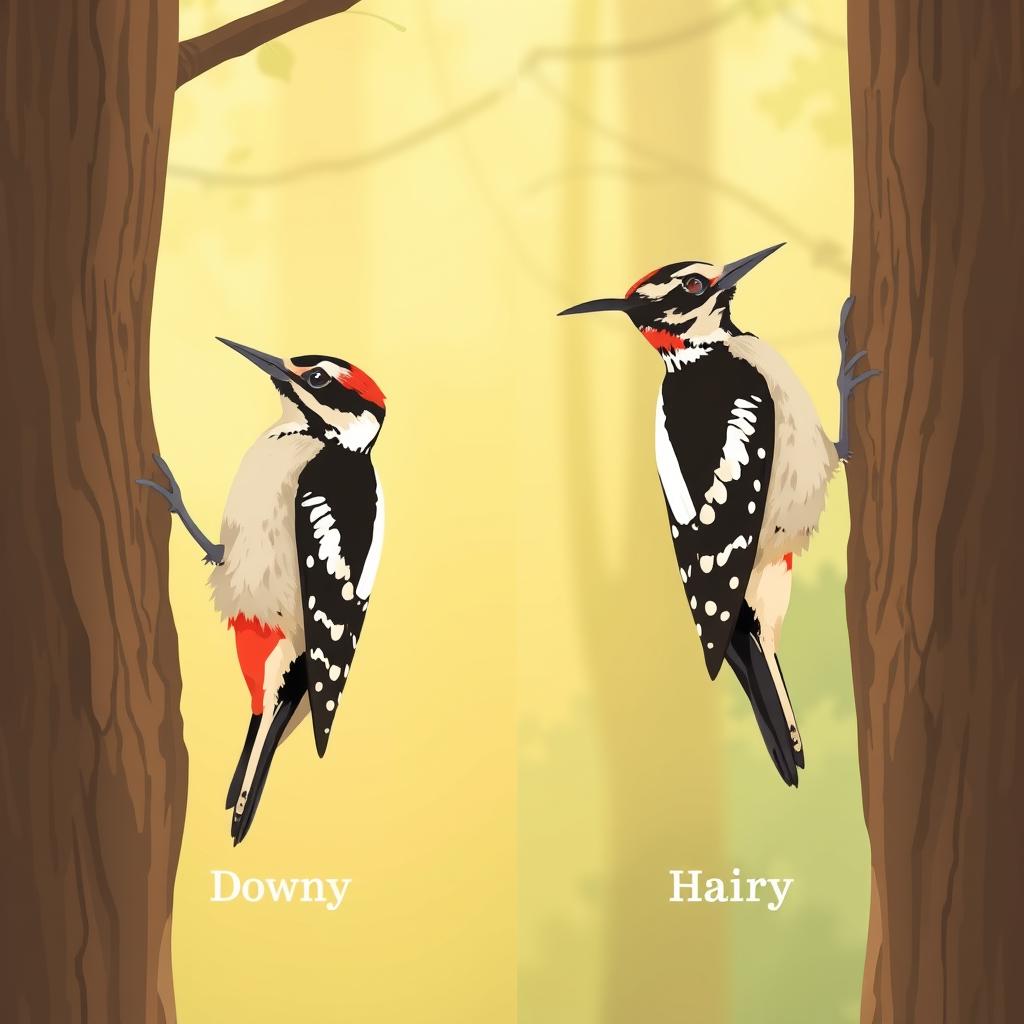
When size comparison isn’t possible, look at the bill—it’s the most reliable single field mark for separating these species. The difference in bill proportions remains consistent regardless of the bird’s angle or distance.
Downy Woodpecker Bill
The Downy’s bill is proportionally tiny and delicate, perfectly adapted for probing into small crevices and extracting insects from bark surfaces:
- Length: About half the length of the head
- Shape: Short, stubby, and pointed
- Appearance: Looks almost too small for the bird’s head
- Function: Perfect for surface feeding and small insect extraction
Hairy Woodpecker Bill
The Hairy’s bill is a robust tool designed for serious excavation work:
- Length: Nearly as long as the head itself
- Shape: Long, straight, and chisel-like
- Appearance: Substantial and proportionate to head size
- Function: Powerful enough to excavate deep into wood
🎵 Calls and Sounds: Listen for the Difference
Once you learn their vocalizations, you can often identify these woodpeckers before you even see them. Their calls are as different as their sizes, reflecting their distinct personalities and behaviors.
Downy Woodpecker Sounds
Downy Woodpeckers have a gentler, more musical quality to their vocalizations:
- Call: Soft, descending “pik” notes
- Whiny call: Distinctive descending “whiny” that sounds almost questioning
- Drumming: Light, rapid tapping that’s quieter than Hairy
- Rhythm: Even-paced, delicate percussion
Hairy Woodpecker Sounds
Hairy Woodpeckers sound as robust as they look:
- Call: Sharp, loud “peek” or “pik” notes
- Rattle call: Harsh, mechanical rattling sound
- Drumming: Loud, resonant hammering on wood
- Power: More forceful and carrying than Downy
🪶 Tail Pattern Clues
While not immediately obvious, the tail patterns provide another reliable identification tool, especially useful when birds are clinging to tree trunks in typical woodpecker fashion.
Downy Woodpecker tail: The white outer tail feathers show distinct black bars or spots, creating a “barred” appearance. These markings are clearly visible when the bird fans its tail or when viewed from behind.
Hairy Woodpecker tail: The white outer tail feathers are pure white without any black markings. This creates a cleaner, more pristine appearance that matches the bird’s overall larger, more “finished” look.
🌳 Behavior and Habitat Preferences
While both species can be found in similar habitats, subtle behavioral differences can provide additional identification clues for the observant birder.
Acrobatic Feeding
More likely to hang upside down on small branches and twigs to reach insects and seeds.
Mixed Flocks
Often joins chickadees, nuthatches, and other small birds in winter feeding flocks.
Feeder Friendly
More comfortable at backyard bird feeders, especially suet feeders.
Powerful Excavation
Capable of drilling deep holes in solid wood to reach beetle larvae and other insects.
Solitary Nature
More likely to forage alone and be territorial around food sources.
Large Tree Preference
Prefers working on substantial tree trunks rather than small branches.
🍯 Diet and Feeding Differences
The size difference between these species translates directly into different feeding strategies and food preferences, which can help with identification in the field.
Downy Woodpecker diet focus:
- Surface insects: Ants, beetles, caterpillars found on bark surface
- Seeds and berries: More likely to eat plant matter, especially in winter
- Small prey: Limited to insects they can reach with their short bill
- Suet: Regular visitors to backyard suet feeders
Hairy Woodpecker diet focus:
- Wood-boring larvae: Beetle and moth larvae deep inside trees
- Large insects: Carpenter ants, adult beetles, caterpillars
- Ant colonies: Can excavate entire ant galleries in dead wood
- Occasional suet: Less frequent feeder visitors than Downys
🪺 Nesting and Family Life
Both species excavate their own nest cavities, but their nesting preferences reflect their size differences and habitat specializations.
Downy Woodpecker nesting: These birds often choose dead or dying branches on living trees, creating cavities 4-12 feet off the ground. Their small size allows them to nest in branches that would be too flimsy for Hairy Woodpeckers, giving them access to nest sites other woodpeckers can’t use.
Hairy Woodpecker nesting: Hairy Woodpeckers typically excavate their nest cavities in the main trunk of dead trees, usually 8-25 feet high. Their powerful bills allow them to work with harder, more solid wood that would challenge smaller woodpeckers.
🗺️ Range and Habitat
While both species have extensive ranges across North America, subtle habitat preferences can provide identification context:
- Downy Woodpeckers: More adaptable to suburban and urban environments, comfortable in parks, yards with mature trees, and edge habitats
- Hairy Woodpeckers: Prefer more mature forests with larger trees, though they’ll visit well-wooded suburbs
- Elevation: Hairy Woodpeckers range higher into mountain forests than Downys
- Territory size: Hairy Woodpeckers maintain larger territories due to their size and food requirements
📸 Photography and Observation Tips
Getting good looks at these woodpeckers for identification requires patience and the right approach:
- Best viewing times: Early morning and late afternoon when they’re most active
- Positioning: Try to observe from multiple angles to see bill proportions
- Suet feeders: Excellent for attracting both species for close observation
- Dead trees: Check snags and dead branches where they commonly forage
- Listen first: Use their calls to locate and identify before seeing them
Frequently Asked Questions
Can Downy and Hairy Woodpeckers hybridize?
While theoretically possible, hybridization between these species is extremely rare in the wild. They’re different enough species that they typically don’t interbreed, and their different habitat preferences and behaviors usually keep them from attempting to mate.
Which species is more common at bird feeders?
Downy Woodpeckers are more frequent feeder visitors. Their smaller size, more social nature, and greater comfort around human activity make them regular backyard birds. Hairy Woodpeckers visit feeders less often and are more wary of human presence.
Do both species migrate?
Both are generally year-round residents throughout most of their range. However, some northern populations may move south in winter, and mountain populations might descend to lower elevations during harsh weather.
Which woodpecker makes bigger holes?
Hairy Woodpeckers create larger, deeper excavations due to their more powerful bills and ability to work with harder wood. Downy Woodpeckers make smaller, shallower holes and often work on softer, more decayed wood.
🎯 Quick Reference Guide
Keep these key points in mind for instant identification:
🏆 Downy Woodpecker — “Dainty”
Small size, tiny bill, soft calls, acrobatic feeding, social with other birds.
⭐ Hairy Woodpecker — “Hefty”
Larger size, long bill, loud calls, powerful drilling, more solitary behavior.
🔍 Red-Flag Feature
Bill proportion is the most reliable single field mark—if the bill looks too small for the head, it’s a Downy; if it looks proportionate or large, it’s a Hairy.
🌟 Final Thoughts: Mastering the Challenge
Learning to distinguish Downy and Hairy Woodpeckers represents a significant milestone in any birdwatcher’s journey. These species test your observation skills and reward careful attention to detail.
Once you master this identification challenge, you’ll find yourself noticing subtle differences in other challenging bird pairs. The skills you develop separating these woodpeckers—attention to proportions, behavior, and vocalizations—will serve you well throughout your birdwatching adventures.
Remember, even expert birders occasionally need a second look at these tricky species. The key is patience, practice, and focusing on the most reliable field marks: size, bill proportions, and calls. Soon you’ll be confidently identifying both species and helping other birders crack this classic identification puzzle.