More than 120 years ago, a small group of bird enthusiasts made a radical decision: instead of shooting birds on Christmas Day, they would count them. That quiet act of rebellion launched what is now the longest-running citizen science project on Earth — a tradition that still takes place every December and January, and that you can join from your own backyard.
The Christmas Bird Count isn't just a charming holiday tradition. It's a massive, coordinated scientific effort that has produced over a century of unbroken data about North American bird populations — data that researchers, conservationists, and policymakers still rely on today.
The Surprising Origin Story 📜
In the late 1800s, a popular Christmas holiday tradition in North America was called the "Side Hunt." Teams of hunters would compete to see who could kill the most birds and small animals in a single day. It was sport, but it was also genuinely destructive to already-declining bird populations.
Frank Chapman, an ornithologist and early officer of the Audubon Society, proposed an alternative. On Christmas Day 1900, he organized the first Christmas Bird Count — not a hunt, but a census. Twenty-seven observers participated across 25 locations in the United States and Canada, counting every bird they saw. The idea was simple and revolutionary: document what's there instead of taking it away.
🗺️ How the Christmas Bird Count Is Organized
The CBC has a beautiful, elegant structure that has remained essentially unchanged for over a century. Understanding it helps you see why the data it produces is so scientifically valuable.
Count Circles
The count is organized into "count circles," each exactly 15 miles (24 kilometers) in diameter. There are more than 2,400 circles across the Western Hemisphere — from Alaska to Argentina. Every count circle has an assigned compiler who organizes the local effort and collects data from all the participants within that circle.
The Count Period
The Christmas Bird Count takes place over a 24-day window from December 14 through January 5 each year. Each count circle chooses one day within this period for its official count. On that day, teams of volunteers fan out across the circle to systematically cover as much habitat as possible from dawn until dusk.
Feeder Watchers
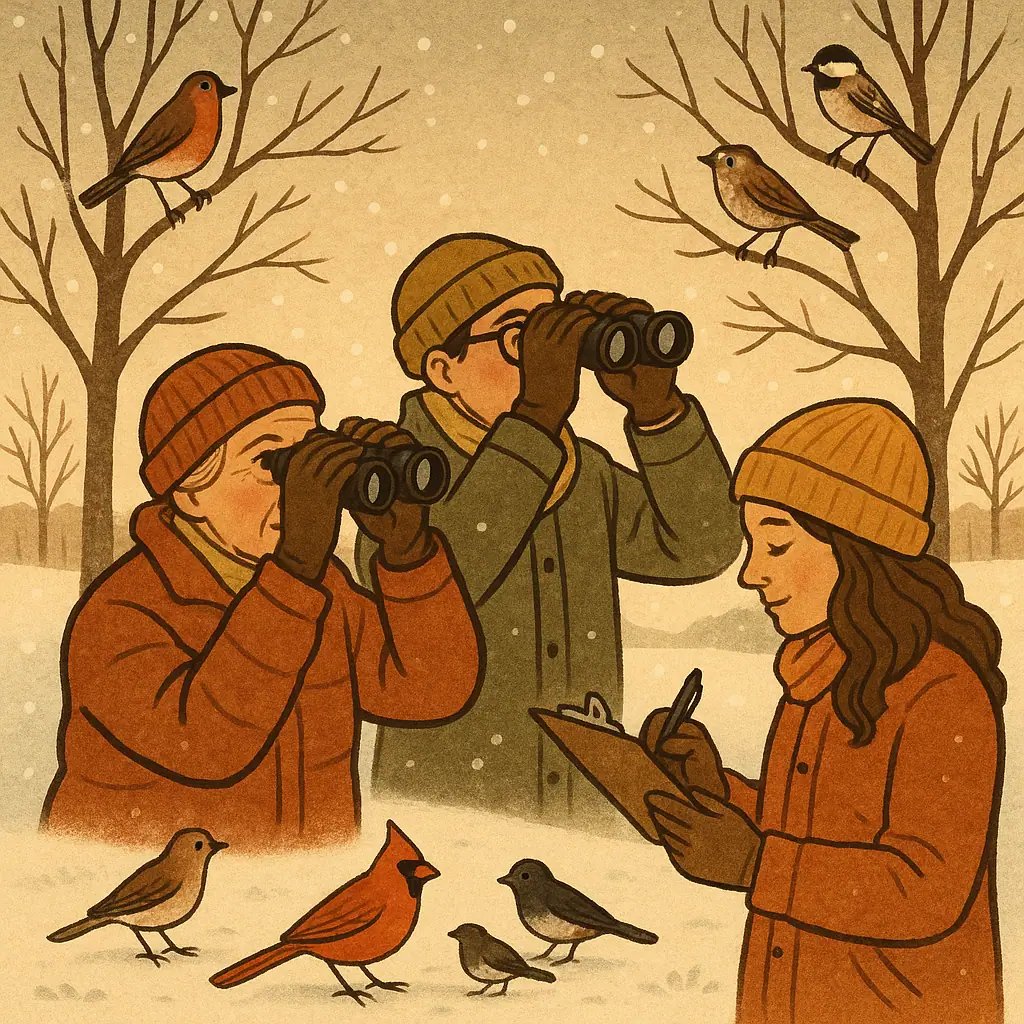
Not everyone needs to go out in the cold. "Feeder watchers" — people who count birds visiting their backyard feeders from inside their home — contribute data just as valuable as field teams, as long as their home falls within a designated count circle. This is often the ideal role for older participants or anyone with mobility limitations.
Why the Data Matters After 125 Years ❄️
Having over 120 consecutive years of bird count data from the same geographic locations is extraordinarily rare in science. Most environmental datasets span decades at most. The CBC's longevity gives researchers the ability to detect trends that shorter studies simply cannot reveal.
- Range shifts: Analysis of CBC data shows that many bird species have shifted their winter ranges northward by an average of 40 miles over the past 50 years — a direct indicator of warming winters linked to climate change.
- Population declines: The CBC has documented the collapse of several once-common bird species long before other monitoring programs detected problems, enabling earlier conservation responses.
- Invasive species tracking: The spread of European Starlings and House Sparrows across North America — and more recently the movement of tropical species northward — has been tracked precisely through CBC records.
- Conservation policy: More than 300 peer-reviewed scientific articles have used CBC data. The count has directly informed decisions under the Endangered Species Act and international migratory bird treaties.
How to Join the Christmas Bird Count 🐦
Joining the CBC is easier than many people expect. Here's how to get started:
- Find your circle: Visit the National Audubon Society website (audubon.org/community-science/christmas-bird-count) and use the interactive map to find count circles near your home. There may be several nearby, each scheduled on different days.
- Contact the compiler: Each circle has a compiler who organizes the local effort. Their contact information is listed on the Audubon CBC page. Reach out and ask how to join — compilers are always grateful for new volunteers.
- Choose your role: Tell the compiler about your experience level and mobility. You might join a field team that surveys by car and on foot, or you might contribute as a home feeder counter. Both matter equally.
- Prepare for the day: Dress in warm layers (field counts run from dawn to dusk in December or January). Bring your binoculars, a field guide or Merlin app, snacks, hot coffee, and comfortable shoes.
Pros and Cons of the Christmas Bird Count vs. Casual Birdwatching
125 years of scientific legacy
Your participation adds to an unbroken dataset that connects you to birdwatchers who counted birds in 1900. That continuity is scientifically priceless.
Structured community experience
The CBC is organized, social, and purposeful. You spend the day with fellow birders who share your interest, guided by someone who knows the local territory intimately.
Home feeder participation is fully valid
If going out in the cold isn't appealing, staying home and counting from your window is a completely legitimate way to contribute.
You must be within a count circle
Unlike the Great Backyard Bird Count (which accepts data from anywhere), the CBC only accepts data from within designated 15-mile circles. Check the map before planning your participation.
Field counts are a full-day commitment
Joining a field team typically means birding from dawn until mid-afternoon or later. It's a wonderful day, but it requires planning and appropriate gear.
Frequently Asked Questions About the Christmas Bird Count
Do I need to be an expert birder to participate in the CBC?
Not at all. Beginners are warmly welcomed, especially as feeder watchers. Many circles actively recruit newcomers and pair them with experienced mentors. The CBC is how countless serious birders got their start — it's a teaching tradition as much as a scientific one.
Is there a registration fee to join the Christmas Bird Count?
Participation is free for most volunteers. Some count circles request a small contribution to cover data processing costs, but this is optional and typically nominal. The National Audubon Society does charge a small fee for official count compilers, but not for general participants.
What happens with the data after the count?
Each circle's compiler collects all the data and submits it to the National Audubon Society, which compiles the full dataset and makes it publicly available for research. The data is archived and accessible to any researcher worldwide. You can actually look up historical CBC data from your own circle going back decades.
How is the Christmas Bird Count different from the Great Backyard Bird Count?
The GBBC (February) is open to anyone, anywhere, with no geographic restrictions — it's a global open snapshot. The CBC (December–January) is organized within specific count circles and requires coordination with a local compiler. The CBC has a much longer history and is more intensively organized, while the GBBC is more casual and accessible for first-time participants.
Final Thoughts ✨
There's a thread of continuity in the Christmas Bird Count that most hobbies can't offer. When you count birds on a December morning in your backyard or alongside a field team in your local park, you're doing exactly what 27 people did on Christmas Day in 1900 — paying attention to the birds, recording what you see, and trusting that the data matters.
It does matter. It has mattered for 125 years. And it will matter for every year that people like you choose to count rather than simply observe in silence.