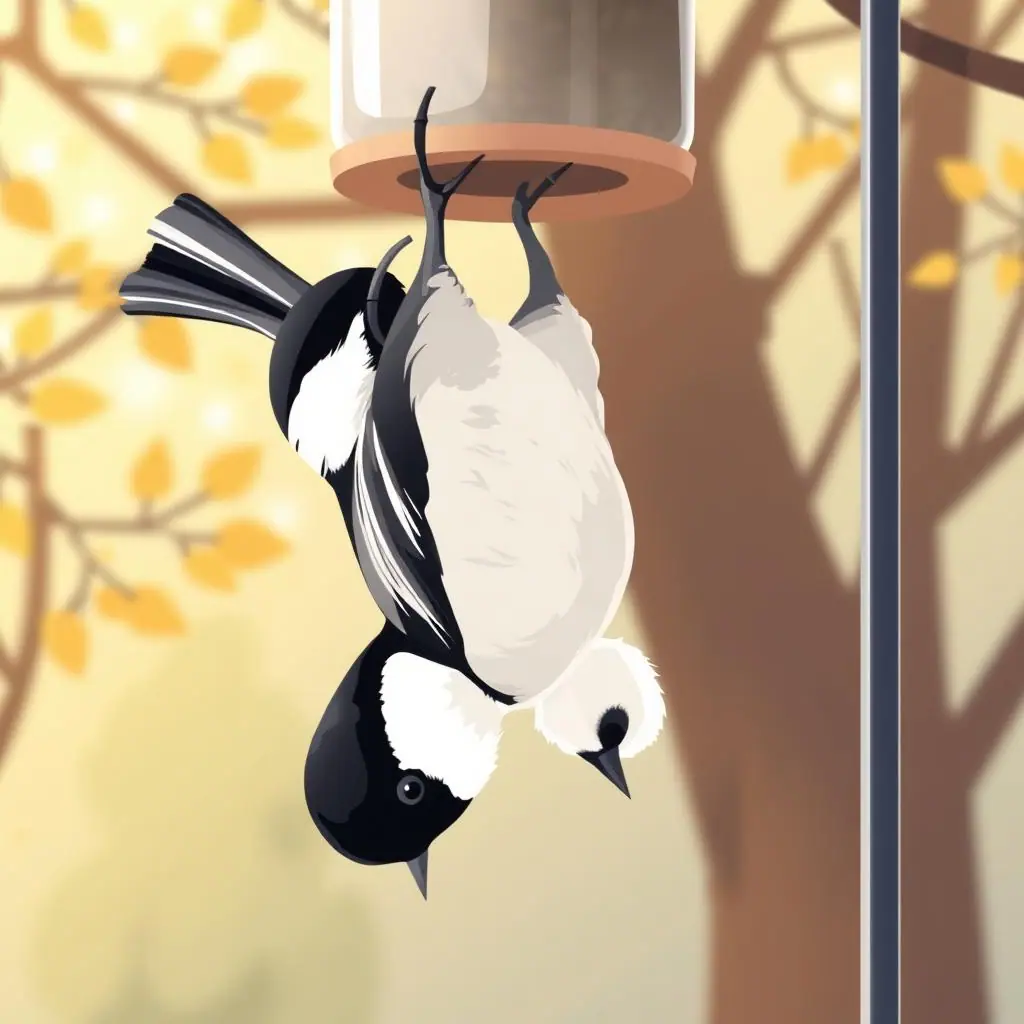
Yesterday morning, I watched a tiny bird perform what looked like aerial gymnastics at my suet feeder. Hanging upside-down with complete confidence, this little acrobat pecked away while maintaining perfect balance – a classic display of black capped chickadee agility and charm.
Few birds capture hearts as quickly as the **black-capped chickadee**. These fearless little performers bring constant entertainment to backyard feeders, combining bold curiosity with gymnastic feeding behaviors. Their willingness to interact with humans, paired with year-round presence, makes them ideal birds for beginning birdwatchers.
Whether you're new to **chickadee identification** or simply want to appreciate these remarkable birds more deeply, understanding their unique characteristics transforms casual observation into genuine connection. Let me share insights from decades of watching these captivating creatures.
🎭 Unmistakable Appearance
**Black-capped chickadee identification** starts with their bold, graphic plumage pattern – nature's version of formal wear that never goes out of style.
Signature Features
The black capped chickadee sports a **solid black cap extending from the forehead to the nape**, creating a distinctive "helmet" appearance. This black cap connects to an equally dark **black bib** that covers the throat and upper chest, like a formal bow tie.
**Pure white cheeks** create striking contrast against the black cap and bib. This white extends around the sides of the neck, giving them an almost cartoon-like appearance that's impossible to miss.
Body Coloration
Beyond their striking head pattern, **black chickadee birds** display subtle but beautiful body colors. Their **back and wings show soft gray tones**, while the **tail appears darker gray with white outer edges** visible during flight.
**Buff-colored sides** warm up their otherwise monochrome appearance, creating gentle transitions between the white underparts and gray upperparts. This soft coloring helps chickadees blend with tree bark when they're not actively feeding.
Size and Proportions
At just 4.75-5.75 inches long with a wingspan around 8 inches, **chickadee birds** rank among our smallest songbirds. They have **large heads relative to their compact bodies**, creating an endearing, almost spherical silhouette that birders describe as "all head and attitude."
🤸 Acrobatic Feeding Behaviors
Watching **black capped chickadees** feed provides endless entertainment. Their gymnastic abilities surpass most circus performers, and they approach feeders with zero fear.
Upside-Down Specialists
**Chickadees excel at inverted feeding** – hanging upside-down from suet feeders, seed ports, and natural food sources. This ability allows them to access food other birds can't reach, giving them competitive advantages at crowded feeders.
Their **strong, tiny feet** provide incredible grip strength, letting them maintain stable positions while working on food items. Watch for their tendency to grab a sunflower seed, fly to a nearby branch, hold it steady with their feet, and hammer it open with precision strikes.
Food Caching Masters
One of the most fascinating **black capped chickadee** behaviors involves their incredible memory for food storage. They **cache thousands of seeds and insects in tree crevices, bark folds, and other hiding spots**, remembering exact locations for weeks.
Studies show they can remember **over 1,000 cache sites simultaneously**, updating their mental maps as they consume stored food and create new caches. This behavior helps them survive harsh winters when food becomes scarce.
- Preferred foods: Black oil sunflower seeds, suet, safflower seeds, and insects
- Feeder types: Tube feeders, suet cages, platform feeders, and hopper feeders
- Feeding times: Active throughout the day, with peak activity in early morning and late afternoon
- Social feeding: Often feed in mixed flocks with nuthatches, titmice, and woodpeckers
🎵 Distinctive Vocalizations
**Black chickadee birds** earned their name from their most recognizable call – a clear "chick-a-dee-dee-dee" that sounds exactly like their name.
The Famous Chickadee Call
The classic **"chick-a-dee-dee-dee" call** serves multiple purposes in chickadee society. The number of "dee" notes actually conveys information about threat levels – more "dees" indicate greater danger, helping flock members assess situations quickly.
During **breeding season (April-June)**, listen for their **sweet, clear whistle** – a two-note "fee-bee" or "hey-sweetie" sound that males use to establish territories and attract mates. This whistle carries much farther than their chattering calls.
Complex Communication
**Chickadees maintain constant vocal contact** with flock members through soft contact calls, aggressive territorial calls, and alarm signals. They're among the most vocal backyard birds, creating a steady soundtrack of cheerful chatter.
Year-round residents
Present in northern regions throughout all seasons, providing consistent viewing opportunities.
Fearless nature
Approach feeders boldly and often allow close human observation.
Active personalities
Constant motion and acrobatic feeding provide endless entertainment.
Easy identification
Distinctive black-and-white pattern makes them unmistakable.
Constant movement
Rarely stay still long enough for detailed observation or photography.
Similar species confusion
Can be confused with Carolina Chickadees in overlap zones without vocal identification.
🏠 Habitat and Range
**Black-capped chickadees** thrive across northern North America, from Alaska to the northern United States, wherever mature trees provide nesting cavities and food sources.
Preferred Environments
These adaptable birds flourish in **mixed and deciduous forests, suburban neighborhoods with mature trees, and parks with diverse plantings**. They need **trees for nesting cavities** but adapt well to human-modified landscapes.
**Black capped chickadees** show strong preferences for areas with **oak, birch, willow, and maple trees**, which provide both nesting sites and abundant insect populations. They also appreciate **coniferous trees for winter shelter and seed sources**.
Seasonal Behavior Patterns
Unlike many songbirds, **chickadees remain year-round residents** throughout most of their range. They form larger flocks during fall and winter, sometimes including 20-30 individuals plus associated nuthatches, titmice, and small woodpeckers.
- Summer: Breeding pairs defend territories and raise 1-2 broods
- Fall: Form mixed-species foraging flocks for winter survival
- Winter: Rely heavily on cached food and backyard feeders
- Spring: Flocks disperse as breeding pairs establish territories
🪺 Nesting and Family Life
**Black chickadee birds** create fascinating family structures centered around excavated nesting cavities and intensive parental care.
Nest Construction
Unlike cavity nesters that use existing holes, **chickadees excavate their own nest cavities** in soft, decaying wood. Both male and female work together, taking turns removing wood chips to create chambers 4-5 inches deep.
They **line cavities with soft materials** – moss, animal hair, feathers, and plant fibers – creating cozy chambers for their eggs and nestlings. The entire excavation process takes 1-2 weeks of dedicated work.
Raising Young
**Female chickadees lay 5-8 small white eggs** speckled with reddish-brown spots. She incubates eggs for about 12-13 days while the male brings food and guards the territory.
**Both parents feed nestlings constantly** for 14-16 days after hatching, making hundreds of feeding trips daily. Young chickadees remain with parents for several weeks after fledging, learning crucial survival skills including food-caching techniques.
❄️ Winter Survival Strategies
**Black-capped chickadees** employ remarkable adaptations that allow them to survive harsh northern winters when many other birds migrate south.
Physiological Adaptations
During extreme cold, **chickadees enter controlled hypothermia** each night, lowering their body temperature by 10-15 degrees to conserve energy. They can survive temperatures well below zero using this strategy.
Their **dense feathers** provide excellent insulation – they actually have more feathers per square inch than larger birds. Watch for their "fluffed up" appearance on cold days as they trap warm air close to their bodies.
Behavioral Adaptations
**Winter flocking behavior** helps chickadees find food more efficiently and provides safety in numbers. These mixed-species flocks often include nuthatches, titmice, creepers, and small woodpeckers that benefit from chickadees' excellent communication skills.
How can I tell black-capped chickadees from Carolina chickadees?
Range is the best indicator – black-capped live in northern areas, Carolina in the south. In overlap zones, listen for calls: black-capped say "chick-a-dee-dee-dee" while Carolina chickadees have faster, higher-pitched calls.
Will chickadees eat from my hand?
With patience, yes! Chickadees are among the most likely birds to hand-feed. Start by sitting quietly near feeders, then gradually extend your hand with seeds. It may take several weeks to build trust.
What's the best feeder setup for attracting chickadees?
Offer black oil sunflower seeds in tube feeders, suet in cages, and consider platform feeders. Place feeders near trees for quick escape routes, and maintain consistent food supplies.
Do chickadees migrate?
Most black-capped chickadees are permanent residents, staying in the same area year-round. Occasional "irruptive" movements occur during winters with poor food supplies, but true migration is rare.
🌟 Creating Chickadee-Friendly Spaces
Attracting **black-capped chickadees** to your backyard requires understanding their preferences for food, shelter, and nesting sites.
**Food variety matters most.** Offer black oil sunflower seeds, suet, safflower seeds, and nyjer in different feeder types. Chickadees appreciate **multiple feeding stations** that accommodate their grab-and-go feeding style.
**Native trees and shrubs** provide natural food sources and nesting opportunities. Consider planting birch, willow, or oak trees for long-term chickadee habitat. Even small yards can support chickadees with thoughtful plant selection and feeder placement.
**Water sources** attract chickadees year-round, especially moving water that doesn't freeze. Simple heated birdbaths or dripping devices create irresistible attractions for these active birds.
Creating **mixed-species habitat** benefits chickadees and their flockmates. The birds you attract alongside chickadees – nuthatches, titmice, and small woodpeckers – form the social networks that help all species survive and thrive.
Your efforts to support **chickadee birds** create ripple effects throughout your local ecosystem. These charismatic little performers serve as gateway birds, inspiring deeper appreciation for all backyard wildlife while providing daily doses of wonder and entertainment.