
Learning bird families for beginners is one of the kindest ways to make backyard birdwatching feel less confusing. Instead of trying to name every visitor right away, you begin by asking, “What kind of bird does this remind me of?”
That small shift helps. A mystery bird may not become an exact species in the first ten seconds, but it can become “sparrow-like,” “finch-like,” “woodpecker-like,” or “dove-like.” Once you know the family neighborhood, the rest of the identification gets much easier.
If you are still building basic observation habits, it can also help to revisit your first week of birdwatching and keep the mood gentle. Backyard birding is not a test. It is a slow practice of noticing.
Why Bird Families for Beginners Matter
Many new birdwatchers start with color because color is easy to notice. A red bird, a brown bird, or a black bird catches the eye. The trouble is that color can change with light, season, sex, age, and distance. Shape and behavior often stay more dependable.
The National Audubon Society keeps a broad guide to North American birds that lets readers explore species by family and compare general patterns. It is a useful outside reference when you want to look up a family group after making your own first observations.
In your own yard, bird families are the practical version of that idea. You are not memorizing a textbook category. You are noticing the kind of body, bill, movement, and feeding style in front of you.
Start With Shape Before Color
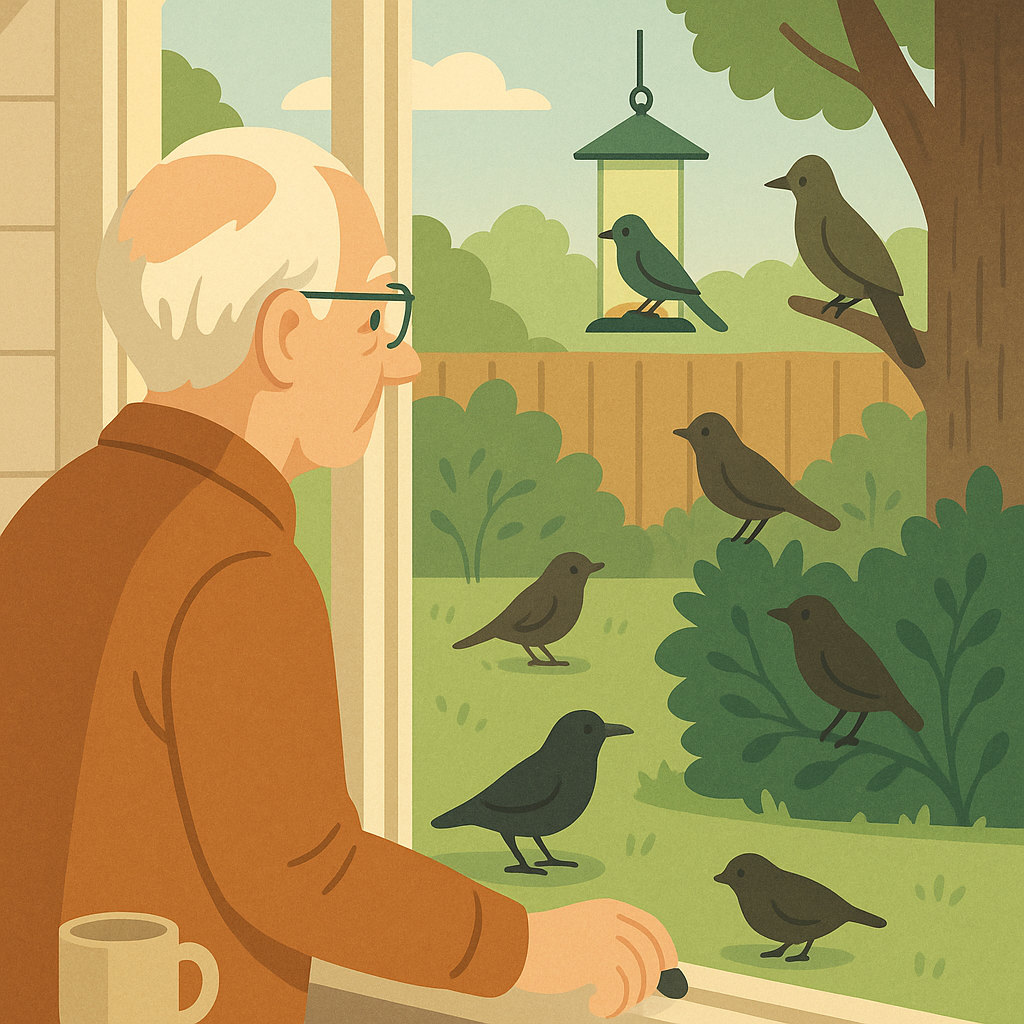
Shape is the quiet clue that keeps helping even when the bird is backlit, partly hidden, or moving quickly. Look at the whole bird before zooming in on tiny marks.
- Body size: Is it smaller than a sparrow, sparrow-sized, robin-sized, or crow-sized?
- Bill shape: Is the bill short and thick, thin and pointed, chisel-like, or long and slender?
- Tail length: Does the tail look short, long, cocked upward, rounded, or sharply pointed?
- Posture: Does the bird sit upright, cling vertically, crouch low, or bob along the ground?
- Movement: Does it hop, scratch, creep, cling, glide, or walk with a steady bob?
For extra practice, pair this with your listening habits. A bird you partly recognize by shape may become clearer when you compare what you see with what you hear, especially if you have already read about understanding bird sounds.
Six Common Backyard Bird Families to Recognize
You do not need every bird family in North America to become a more confident backyard observer. Start with the groups that many beginners are likely to see around feeders, shrubs, lawns, fences, and trees.
Sparrows: small, streaky, and close to the ground
Sparrows often look brown, tan, or gray at first glance. They may seem plain until you notice their habits. Many stay low, hop through grass, scratch near leaf litter, or perch inside shrubs rather than posing boldly in the open.
Look for a small bird with a conical seed-cracking bill, quick hops, and a preference for edges: fence lines, brush, garden beds, and ground under feeders. Do not worry if sparrows feel difficult. They are famous for teaching patience.
Finches: seed lovers with neat, sturdy bills
Finches often seem a little more rounded and feeder-friendly than sparrows. Their bills are usually short, thick, and tidy, built for seeds. House Finches may gather at tube feeders, while American Goldfinches often bring a bouncy flight and bright seasonal color.
The most useful beginner clue is not brightness. It is the bill. A small bird with a strong little seed bill, active feeder behavior, and a social mood may belong in your finch folder.
Wrens: small birds with big energy
Wrens are often tiny, restless, and full of voice. Many hold the tail cocked upward, slip through brush, and investigate corners as if they own the whole yard. A wren may pop into view for one second and vanish the next.
If you see a small brown bird with a lively posture, quick movement, and a surprisingly loud song, pause before calling it “just a sparrow.” It may be a wren, especially near shrubs, brush piles, woodpiles, or porch edges.
Woodpeckers: vertical climbers with chisel bills
Woodpeckers are easier to place by behavior than by color. They cling to trunks, branches, suet feeders, and sometimes utility poles. Their bodies often look upright against the surface, with stiff tails helping them brace.
The bill is usually straight and chisel-like. If a bird is hitching up a tree trunk instead of perching across a branch, you are likely in woodpecker territory.
Doves: soft shapes and gentle movement
Doves tend to look plump, smooth, and small-headed for their body size. Mourning Doves often walk on the ground, bob their heads gently, and fly up with quick wing whistles. They may gather under feeders to clean up fallen seed.
Their calm shape is a clue: rounded body, tapered tail, small head, and a soft-looking outline. They are usually not as jumpy and busy as sparrows or finches.
Blackbirds: bold posture, longer bodies, and open spaces
Blackbirds can include several common yard and neighborhood visitors, such as Red-winged Blackbirds, grackles, and cowbirds. They often look longer-bodied and more assertive than sparrows or finches, with a steady walk and strong presence on lawns or near water.
Some are glossy, some are plain, and some show patches of color. For beginners, focus first on posture, flock behavior, and habitat. A dark bird walking boldly through grass may be more “blackbird-like” than “crow-like” if it is much smaller than a crow.
Practice With One Backyard Session
A simple ten-minute session can teach more than a long search through field guides. Sit where you normally watch birds. Choose one bird at a time. Before opening an app or book, write down three family clues.
- First, note the bird’s size compared with a familiar bird, such as a sparrow, robin, or crow.
- Next, describe the bill in plain words: tiny, thick, pointed, long, curved, or chisel-like.
- Then, describe the movement: hopping, walking, clinging, bobbing, scratching, hovering, or creeping.
- Finally, note where the bird chose to be: ground, feeder, tree trunk, shrub, fence, water, or open lawn.
This habit works especially well if you keep a few notes over time. A simple page in a notebook can reveal patterns you missed in the moment. If you like that approach, the guide to using a birdwatching notebook for identification makes a natural next step.
Pros and Cons of Learning by Bird Families
Reduces overwhelm
You can make a useful observation without forcing an exact species name too quickly.
Builds better habits
Shape, bill, behavior, and habitat train your eye in ways that help with many future birds.
Works at a distance
Family-style clues often remain visible even when color details are hidden by shade or backlighting.
Some families still overlap
Small brown birds, young birds, and female birds can still require careful comparison.
It does not replace field marks
Family clues narrow the search, but exact identification may still need color pattern, range, sound, and season.
A Simple Backyard Family Checklist
Use this checklist when a bird appears and your mind goes blank. It keeps the process calm and repeatable.
- If it clings vertically to bark: think woodpecker first.
- If it walks softly under the feeder with a plump body: think dove.
- If it is small, brown, low, and scratchy: think sparrow or wren, then check tail posture and behavior.
- If it has a sturdy seed bill and likes feeders: think finch.
- If it is dark, bold, and walking in open grass: think blackbird family before assuming crow.
- If it vanishes into shrubs and sings loudly: think wren or another thicket-loving bird.
When to Use an App or Field Guide
Apps and field guides are most helpful after you have made your first observation. Instead of asking the tool to do everything, give it a head start: “small bird, thick bill, feeder, brown streaks,” or “upright bird, tree trunk, chisel bill.”
That is also a good moment to compare family clues with location and season. A bird family may be common in one region and rare in another. When you are unsure, use a trusted guide, keep the sighting tentative, and enjoy the learning.
If vision, mobility, or window placement limits what you can see, that still counts. Many family clues come from behavior and location, not perfect close-up detail. The article on backyard birdwatching with limited mobility has more gentle ways to make the view work for you.
Frequently Asked Questions
What is the easiest bird family for beginners to recognize?
Woodpeckers are often one of the easiest because their behavior is so distinctive. If a bird is clinging vertically to a tree trunk or suet feeder and using a straight, chisel-like bill, you can usually place it in the woodpecker group before worrying about the exact species.
Are sparrows and finches the same kind of bird?
No, but beginners often confuse them because both can be small and seed-eating. Finches usually have a neat, sturdy seed bill and are common at feeders. Sparrows are often more streaky, low to the ground, and tied to brush, grass, or edges.
Should I learn bird families before species names?
It is a very helpful order. You can still learn favorite species as you go, but family-style clues help you narrow the possibilities faster and feel less overwhelmed when several unfamiliar birds appear at once.
What if I guess the wrong bird family?
That is normal. Treat each guess as practice, not failure. Write down what made you choose that family, then compare the bird with a trusted guide. Over time, your first impressions become steadier.
Final Thoughts
Recognizing common bird families is like sorting a drawer before labeling every item inside it. You are giving your mind a calmer way to organize what your eyes already notice: shape, bill, movement, posture, and place.
The next time a bird lands in your yard, pause before naming it. Ask what family style it belongs to. That one question can turn a confusing flash of feathers into a clear little discovery.